
DEADLINES DONNIE’S PLAYBOOK: The Tactic Trump Uses to Shape the Story Without Making the Call
They sound urgent. They spark headlines. Then they vanish, just like he planned.
by Met Middleson
June 19, 2025



From TikTok divestment orders to trade negotiation cutoffs, foreign aid pauses to two week military clocks, Donald Trump has built a presidency and a career around deadlines that rarely land where they start. Some come with threats of force. Others with the promise of diplomacy. But whether they expire, get extended, or quietly disappear, they all serve the same purpose: shaping perception while keeping the outcome on his terms. And this week, he set two more.
DEADLINES AS WEAPONS
Deadlines are supposed to drive decisions. In Trump’s hands, they drive perception.
For most leaders, a deadline signals commitment. A firm line meant to focus action. For Trump, it is something else entirely. A looming date makes headlines. It rattles rivals. It projects urgency. And when the moment comes, it can be extended, reframed, or ignored entirely.
This is not a political quirk. It is a strategic pattern. Trump does not rely on policy clarity to assert control. He uses timing. Fluid, self-imposed, and designed to shift the pressure onto everyone else. Whether he is threatening to strike, pulling funding, or banning an app, the message is consistent. The clock is ticking, but only he decides when or if it hits zero.
THE CYCLE
It always starts the same way. A hard deadline. A short fuse. A declaration that something big will happen if action is not taken by a certain date. Markets react. Media coverage spikes. Political allies rally or retreat.
Then the clock runs out.
But instead of delivering the promised action, Trump shifts the timeline. Sometimes he extends it. Sometimes he says it was never about the date at all. Sometimes he simply moves on, claiming victory whether or not anything happened.
This pattern has repeated itself across nearly every major policy arena. Tariff hikes were announced, then paused. Troop withdrawals were promised, then reversed. TikTok was given a shutdown date, then two more. Iran was given two weeks. So were China, Ukraine, and Congress.
THE TECH TIMER
The clearest example of Trump’s deadline strategy in action is TikTok.
Under the Protecting Americans from Foreign Adversary Controlled Applications Act, TikTok faced a legal deadline of January 19, 2025, to divest from Chinese ownership or be banned in the United States. That date was not set by Trump, but by law. Still, once he returned to office, he took full control of the timeline.
On January 20, one day after the law’s deadline, Trump issued an executive order delaying enforcement. He cited national security concerns, but said the administration needed time to review its options. In April, he extended the deadline again. In June, he extended it a third time, this time by ninety days, pushing the decision past September.
At each step, the White House framed the delays as strategic. Review was ongoing. Talks were promising. No one needed to panic.
But the ban never came. The deadlines did. They made news, forced corporate lobbying, triggered diplomatic responses, and kept TikTok in a state of limbo. It was a textbook Trump move. The threat was the point. The deadline was a means to hold leverage, not to resolve it.
THE STRIKE CLOCK
On June 19, 2025, White House Press Secretary Karoline Leavitt read a statement from President Trump: “Based on the fact that there’s a substantial chance of negotiation that may or may not take place with Iran in the near future, I will make my decision whether or not to go in the next two weeks.”
The message made headlines, but the language was anything but firm. A substantial chance of talks. That may or may not happen. In the near future. And a decision in the next two weeks. Every phrase was a hedge. The urgency sounded clear, but the commitment was buried in ambiguity.
This approach is consistent. Earlier this year, when asked about imposing new sanctions on Russia, Trump said, “It’s in my brain the deadline,” declining to provide any specific timeline. It was a signal, not a schedule.
Deadlines tied to NATO cost sharing and Ukraine aid have followed the same pattern. The White House or the president sets an expectation. Then the timeline slips, the issue fades, or the narrative shifts. The original deadline disappears, replaced by a new one or none at all.
Each of these clocks serves a purpose. They generate pressure, invite speculation, and keep the spotlight fixed on Trump as the sole decision maker. Whether or not anything happens is beside the point. What matters is that everyone believes something might.
THE STRATEGIC ADVANTAGE
Deadlines are not just pressure points in Trump’s approach. They are positioning tools. By declaring a ticking clock, Trump creates the illusion of motion, even when no action is taken. The world watches the countdown. Allies react. Opponents brace. And Trump remains at the center of it all .
The advantage is twofold. First, it shifts attention away from policy details and toward the drama of the moment. Instead of debating the terms of a deal or the risks of escalation, the conversation becomes about when something might happen. That uncertainty gives Trump space to maneuver without making early concessions.
Second, it turns indecision into dominance. By controlling the timeline, he controls the narrative. Even when deadlines lapse or change, the fact that they were his to set reinforces the image of power. The pressure feels real, even if the resolution never arrives.
This tactic plays well on the world stage, where perception often moves faster than outcomes. And it keeps Trump exactly where he prefers to be: unpredictable, uncommitted, and undeniably in control.
THE COST
While deadline politics can create leverage in the short term, they come with consequences.
For allies, the lack of follow-through creates confusion and instability. Military planners and diplomats are left waiting for decisions that may never come. Public commitments are made, then quietly walked back. International coordination becomes harder when no one can trust the calendar.
For adversaries, the tactic becomes predictable. The first few countdowns may trigger real concern. But after enough delays, they begin to see the pattern. Threats lose their edge. The message becomes noise.
At home, the public becomes desensitized. Urgent timelines start to feel performative. Whether it is a strike window, a trade deal, or a national security warning, the repeated use of deadlines without delivery weakens trust. Americans stop expecting results—and start expecting resets.
What begins as a tactic to command attention slowly erodes credibility. Over time, even the sharpest threat loses its shape.
THE FINAL COUNTDOWN
Donald Trump does not treat deadlines as destinations. He treats them as devices. Tools to amplify pressure, shift blame, or create suspense. The pattern is not accidental. It is deliberate. And by now, it is familiar.
He announces the clock. He drives the headlines. And when the time runs out, he decides whether to act, extend, or walk away entirely. The strength is never in the follow-through. It is in the build-up.
This is the playbook. It spans from TikTok to Tehran, from trade to troop movements. It is not about delivering results on time. It is about holding the room until everyone else flinches.
In Trump’s America, the countdown is rarely about what happens at zero. It is about who gets to decide when the clock even starts.
MET-aphorically Speaking
A Trump deadline is not a finish line. It is a spotlight on a stage that keeps moving.
One moment, it is a ticking clock over Tehran. The next, it is a countdown over Capitol Hill. Then it resets, shifts, or disappears. But the audience stays watching, because the tension is the point.
Deadlines, in this playbook, are not tools to close the deal. They are the sound cue before the curtain rises.
ECHOES BEFORE IMPACT: Two Presidents, One Playbook for Preemptive War
We’ve heard the justifications before. This time, they’re moving faster.
by Met Middleson
June 18, 2025
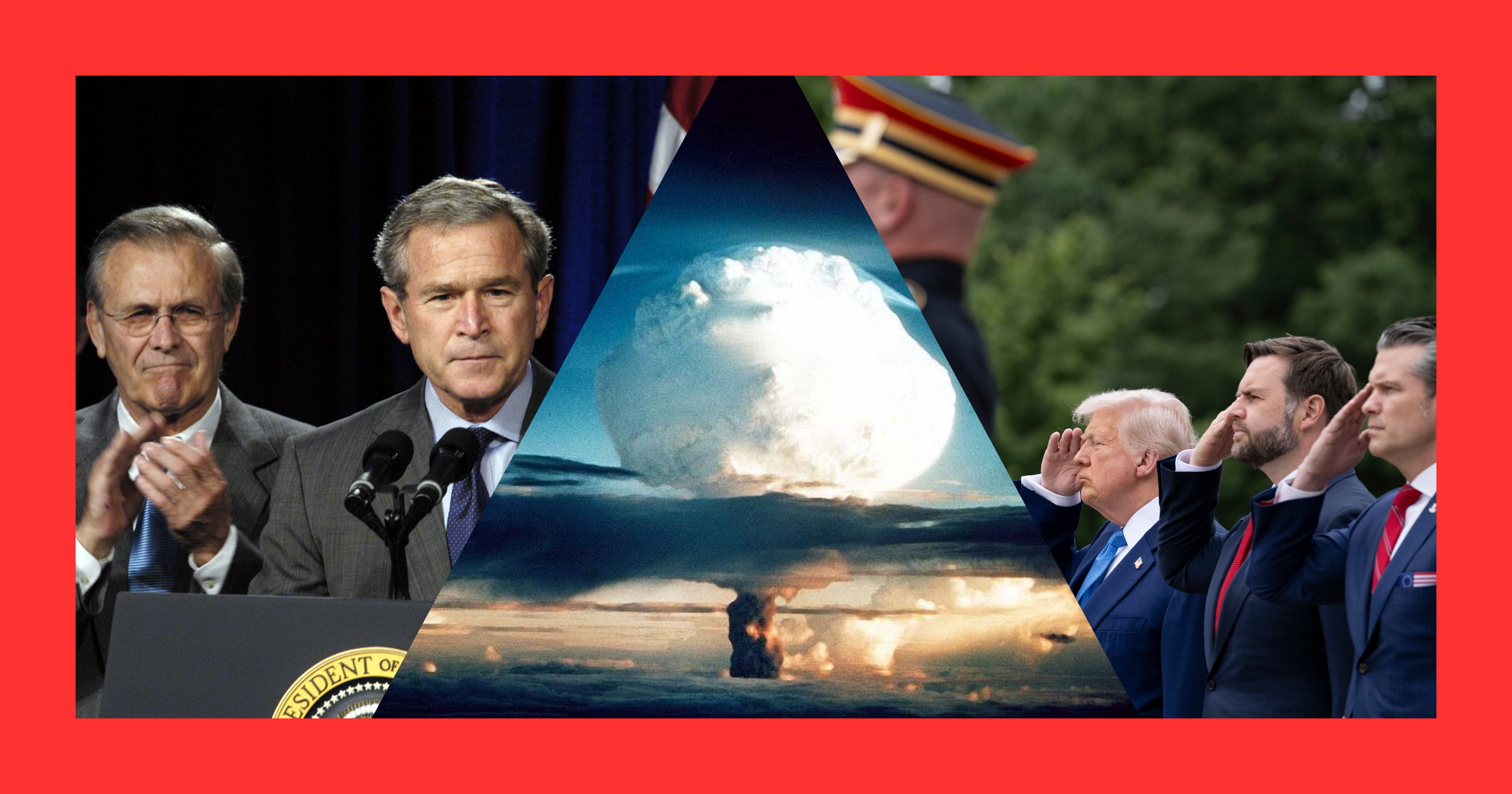
The Bush administration moved quickly. Within hours of the attacks, senior officials were reportedly asking how to link Saddam Hussein. By late 2002, the White House had shifted its focus. Iraq was cast not as an immediate threat but as a future one America could not afford to ignore. Intelligence was cited. Warnings were issued. And eventually, a doctrine took shape: preemptive war to prevent catastrophe.
Now, there has been no single catastrophe, but there was a countdown. In April, President Trump allegedly gave Iran 60 days to strike a deal or face consequences. No formal negotiations followed. Instead, in mid-June, Israel launched Operation Rising Lion, a sweeping assault on Iran’s nuclear facilities, senior military leadership, and key scientists tied to its weapons programs. Just hours later, Trump confirmed the deadline had expired and praised the strikes. “There’s more to come,” he warned, while calling on both sides to “make a deal.”
Both administrations began their war posture with the framing of urgency and inevitability. Bush had a national trauma. Trump had a self-imposed clock. For Bush, the enemy was accused of harboring weapons of mass destruction. For Trump, the message is that Iran is getting too close to having them. One started with fire on American soil. The other started with firepower in another country’s airspace. But both set the tone with the same idea: the window to act is closing, and delay is danger.
THE CASE FOR THREAT
In the lead-up to the Iraq War, the Bush administration built its case around intelligence that was later discredited. A 2002 National Intelligence Estimate claimed Iraq had chemical and biological weapons and was reconstituting its nuclear weapons program. These claims were amplified by senior officials, most notably when Secretary of State Colin Powell addressed the United Nations, citing satellite photos, intercepted communications, and aluminum tubes supposedly meant for uranium enrichment. Powell also warned of mobile bioweapons labs and connections to al-Qaeda. After the invasion, none of the weapons were found. Multiple reviews, including by the Senate Intelligence Committee and the British Butler Review, concluded that much of the intelligence was overstated, selectively presented, and in some cases based on fabricated sources like the informant known as Curveball.
Now, the Trump administration has pointed to the threat of Iran’s nuclear ambitions as justification for escalating pressure. But rather than relying on its own intelligence agencies, the administration has leaned heavily on the claims of Israeli Prime Minister Benjamin Netanyahu. In early June, Netanyahu held a televised briefing in which he claimed Iran had resumed weapons-related nuclear work, including research on neutron triggers and warhead design. The White House echoed those warnings, praising Israel’s vigilance and framing its recent airstrikes as justified and necessary.
U.S. intelligence assessments have told a different story. While agencies acknowledge that Iran has expanded its enrichment and positioned itself to potentially build a weapon, they continue to report that Iran has not made the political decision to pursue a nuclear bomb. In March, Director of National Intelligence Tulsi Gabbard testified before Congress that Iran is not actively building a nuclear weapon and that Supreme Leader Khamenei has not authorized a weapons program.
President Trump dismissed that testimony directly. While aboard Air Force One, he told reporters, “I don’t care what she said. I think they were very close to having one.” The moment underscored a growing divide between presidential messaging and official intelligence findings. The urgency, in this case, is not being driven by classified assessments. It is being driven by foreign claims and political instinct.
Both administrations presented worst-case scenarios to justify preemptive action. Bush claimed the U.S. could not wait for proof of a threat that might already exist. Trump claims the U.S. cannot afford to ignore a threat that might soon become real. Bush had Powell at the United Nations. Trump has Netanyahu and Truth Social. In both cases, the intelligence community offered more caution than the commander-in-chief, but the warnings to the public leaned toward fear over fact.
THE SALES PITCH
The Bush administration sold the Iraq War through a potent mix of fear and moral obligation. Officials warned that waiting for certainty could be fatal. Condoleezza Rice famously said, “We do not want the smoking gun to be a mushroom cloud.” President Bush told Americans that Saddam Hussein hated freedom, gassed his own people, and could give weapons of mass destruction to terrorists. The language was urgent, emotional, and moralistic. The United States was not just defending itself. It was liberating a nation and spreading democracy. Critics were cast as naive at best and unpatriotic at worst. The question was not whether America should act. It was whether America had the courage to act in time.
Trump’s messaging has echoed similar themes but filtered through a more personal and provocative tone. In public remarks and posts, he has described Iran as a rogue regime on the edge of nuclear capability. He warns of unthinkable consequences and demands unconditional surrender. The pitch is not framed as spreading democracy but as asserting dominance. Instead of solemn warnings from a podium, the fear comes through sudden social media posts that signal potential conflict without warning. Trump does not ask for unity. He declares strength. And when challenged, such as by Tulsi Gabbard’s testimony, he dismisses dissent as irrelevant. The moral dimension is framed not as America’s duty to free others, but as its right to crush threats before they take shape.
Both presidents have used fear as a tool to shape public opinion and position themselves as wartime leaders. Bush framed the threat through morality and collective sacrifice, urging Americans to act before tragedy struck again. Trump presents the threat through strength and resolve, signaling that decisions are already made and resistance would be weakness. Bush asked the country to act with him. Trump dares it to fall in line. With Bush, fear came before the bombs. With Trump, it is building in real time. In both cases, fear is not simply a response to conflict. It is part of the campaign to justify it.
MEDIA AND MESSAGING
The Bush administration relied on traditional media structures to shape the case for war. Cable news, Sunday shows, and prime-time addresses became delivery systems for carefully crafted talking points. Intelligence was selectively leaked to trusted outlets, creating headlines that could later be cited as evidence. The press played a central role, sometimes knowingly, sometimes not, in echoing claims about weapons of mass destruction. The tone was institutional. Briefings came from the podium. The language was sober but urgent. By the time Colin Powell stood before the United Nations with satellite photos and intercepted calls, the groundwork had already been laid. The messaging was formal, consistent, and built to persuade not just the American public but the international community.
The Trump administration has taken a radically different approach. Messaging is not driven through formal briefings but through Truth Social posts, impromptu remarks to reporters, and selectively granted interviews. The tone is less institutional and more personal, often emotional and deliberately unpredictable. Warnings appear with little context. Praise for allied strikes is offered before official U.S. statements are released. When contradictions arise, such as between Trump and his own intelligence chief, the administration does not clarify them. It simply moves forward. Narrative control is not about discipline. It is about volume, repetition, and projecting strength. Where Bush aimed to construct a case, Trump aims to dominate the conversation.
Bush used the media to validate a long-form argument. Trump uses the media to deliver immediate impact. One treated the press as a partner in persuasion. The other treats it as a rival to overpower. Bush administration officials coordinated their message in private before delivering it in public. Trump broadcasts the message first and lets his team react afterward. Both strategies seek to manage perception. But while Bush built a structure to justify war, Trump is building pressure in real time, with each message shaping what comes next.
ALLIES AND OPPOSITION
In the months before the invasion of Iraq, the Bush administration invested heavily in building what it called a “coalition of the willing.” While major partners like the United Kingdom, Australia, and Poland joined the U.S. effort, other key allies were skeptical or outright opposed. France and Germany resisted U.N. authorization for war, leading to visible fractures within NATO and the Security Council. Despite the lack of a new U.N. resolution, the Bush administration pressed forward, framing allied support as a sign of moral clarity and dismissing opposition as appeasement. The coalition became a symbol not of global unity but of selective alignment. America did not act alone, but it also did not wait for consensus.
The Trump administration has shown little interest in building a broad coalition. Instead, it has leaned almost entirely on Israel. The White House has echoed Israeli claims, praised its military actions, and declined to offer any public caution in response to escalating strikes. Traditional U.S. allies have voiced concern. France has warned against a regional war. NATO partners have largely remained silent or urged de-escalation. Trump, however, has focused on bilateral strength, not multilateral diplomacy. In statements and social posts, he frames Israel not as one voice among many, but as the only one that matters. There is no talk of joint resolutions or international mandates. There is only support for a partner already in motion.
Bush sought a coalition to give war a global frame, even if the support was partial and fractured. Trump is bypassing the coalition model entirely, aligning U.S. posture with a single ally already in motion. Bush tried to convince the world. Trump appears ready to let the world react after the fact. In both cases, the United States moved forward with limited approval. But only one administration tried to make the case beyond its inner circle.
DOMESTIC POLITICAL UNITY OR DISSENT
In the run-up to the Iraq War, Congress coalesced around the administration’s position. The 2002 Authorization for Use of Military Force passed with strong bipartisan majorities, including key Democratic votes. Vocal dissent existed, including from Senators Robert Byrd and Representative Barbara Lee, but critics often faced social backlash and marginalization. The post-9/11 atmosphere emphasized solidarity. Questioning the war was portrayed as unpatriotic, and dissent was largely overshadowed by a unified campaign to act.
The current Congress presents a more divided picture. Israel’s strikes on Iran have received broad praise from Republicans and from pro-Israel Democrats such as Senate Majority Leader Chuck Schumer and House Democratic Leader Hakeem Jeffries. However, the question of direct U.S. military involvement has generated more pushback. Senators Tim Kaine and Bernie Sanders have supported a new War Powers Resolution that would block unilateral military action without congressional approval. Representatives Ro Khanna and Thomas Massie have voiced similar positions. Meanwhile, Republicans like Senator Rand Paul have argued that any strike by the United States would require explicit congressional authorization. Despite that, key Republican leaders in both chambers have expressed confidence in Trump’s authority and have emphasized their support for a strong response to Iran. The result is bipartisan alignment against Iran’s government, but growing debate over how far the president can go without a vote.
Under Bush, Congress granted legal authority before military action began. Under Trump, Congress is watching the situation unfold without having voted on a clear mandate. Both moments feature bipartisan support for confronting a perceived threat, but the structure of that support differs. Bush secured a formal resolution and broad political cover. Trump is operating in a legal gray zone, with opposition forming not around the threat itself, but around how far the president can act without permission. That distinction may prove crucial if the conflict escalates without a formal vote, or clear public consent.
MET-aphorically Speaking
A match and a fuse. That is what both moments have in common. In 2002, the match was fear and the fuse was long. The Bush administration spent months building a case, assembling support, and preparing the public. When the fire finally reached its target, it carried the weight of political unity and international defiance, even as the foundations later crumbled.
Now, the match is ego and the fuse is short. The Trump administration is not building consensus. It is testing limits. Each post, each strike, each rhetorical escalation pushes the boundary further. There is no resolution on the table. There is no clear line drawn. Just a slow burn, inching toward the moment when reaction becomes reality.
Wars do not always begin with declarations. Sometimes they begin with silence, signals, and the belief that history will not repeat itself, until it does.
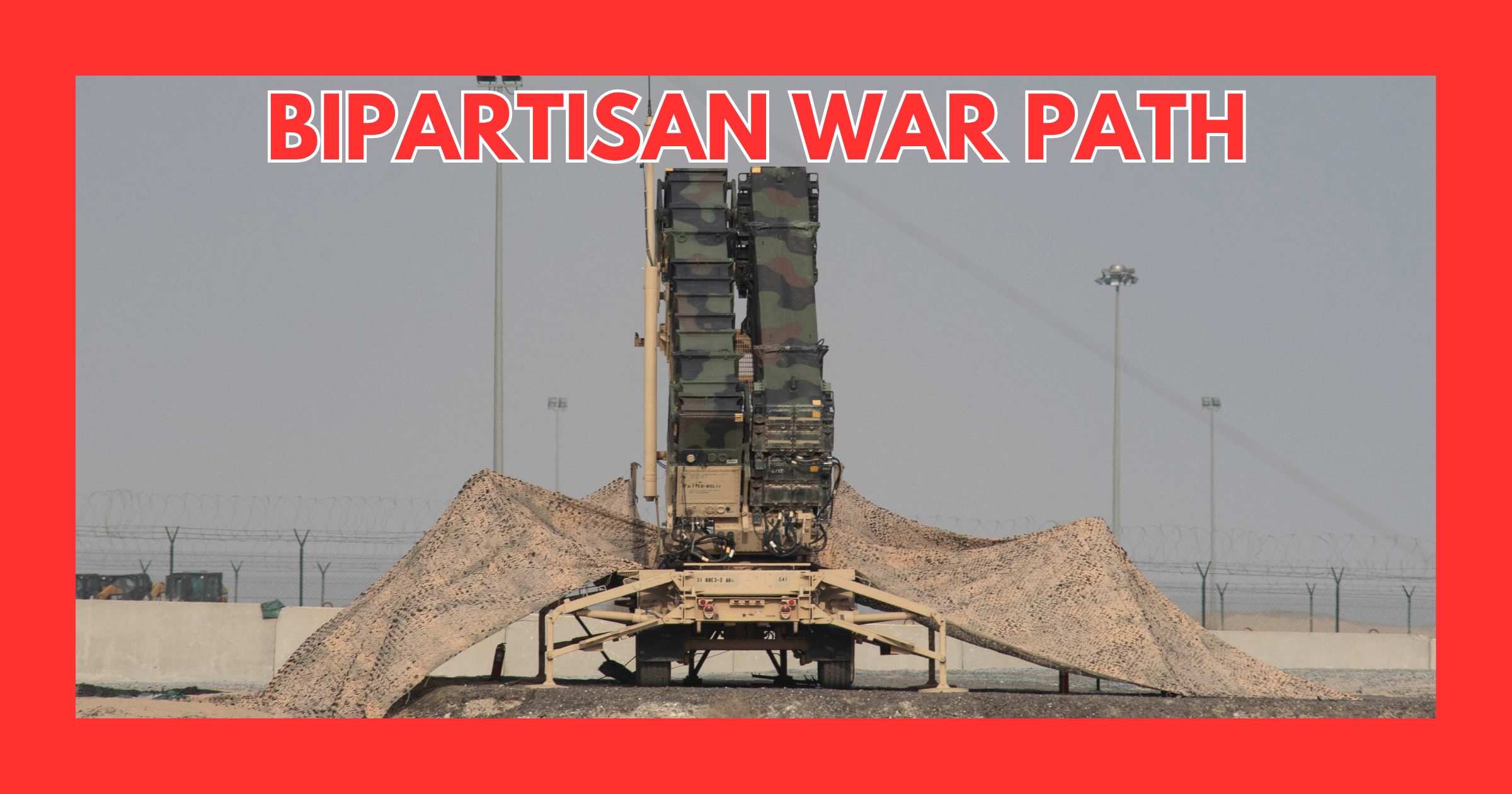
Photo by: SSgt Kenneth Boyton – CENTCOM
Bipartisan War Path: The Iran Strike Both Parties Have Already Endorsed
Partisan lines may run deep, but on retaliation against Iran, they’ve already been erased.
by Met Middleson
June 15, 2025
The conflict between Israel and Iran has entered a dangerous new phase. After Israeli warplanes struck deep into Iran, targeting nuclear sites, command centers, and senior IRGC officials, Iran responded with a wave of missile and drone attacks on Israeli cities. Now Tehran is signaling that U.S. forces could be next. With American troops spread across the region and both political parties in Washington already voicing support for a military response, the window for staying out of this war may already be closing.
THE FLASHPOINT MOMENT
Air raid sirens pierced the night in Tel Aviv as hundreds of drones and missiles filled the sky. Some were intercepted. Some landed. Fires burned across parts of central Israel, while inside Iran, the fallout from Israeli airstrikes had already left hundreds dead, including senior military officials, nuclear scientists, and civilians. The scale of the exchange on both sides was unlike anything seen in decades.
What began with the opening wave of an Israeli campaign targeting Iran’s missile and nuclear infrastructure has now spiraled into a regionwide emergency. Iran’s retaliatory strike, called Operation True Promise III, launched over 150 ballistic missiles and more than 100 drones toward Israeli cities.
By the end of the first wave, Iran had suffered over 400 deaths and more than 650 injuries from Israeli strikes. Tehran’s response left at least 14 Israelis dead and nearly 400 injured. With Iranian officials now threatening to expand retaliation beyond Israel, U.S. forces may be next.
For the first time since the height of the Soleimani crisis in 2020, American military personnel stationed across the Middle East are facing direct and open threats from Iran. And this time, the warnings from Washington are not just coming from one party or one branch of government. They are coming from across the aisle and they are coming fast.
TARGETS WITHIN RANGE
The United States has thousands of troops positioned across the Middle East, many of them stationed within reach of Iranian drones, missiles, or proxy militias. From airfields in Iraq to naval assets in the Red Sea, these personnel now face a heightened threat that Iran has publicly acknowledged.
Among the most likely targets are U.S. bases in Iraq, Syria, and Jordan, where troops support counterterrorism missions and regional stability operations. The al-Tanf garrison in Syria sits in a strategic corridor connecting Iranian forces in Iraq to Hezbollah fighters in Lebanon. It has been targeted by drone swarms before, and military officials say it remains one of the most vulnerable forward operating positions in the region.
Further east, U.S. installations in Kuwait, Qatar, and Bahrain host command centers, interceptor batteries, and logistics hubs. These bases are equipped with advanced missile defense systems, but their visibility makes them symbolic targets. In recent months, Iranian-backed Houthi forces in Yemen have launched drones that reached as far as Eilat in southern Israel, demonstrating expanded range and growing capability.
At sea, American naval groups operating in the Persian Gulf and Red Sea face threats from drones and ballistic missiles launched from Iran or its proxies. The USS Dwight D. Eisenhower carrier group has been conducting defensive operations and joint patrols in the region. If Iran views U.S. naval activity as interference in its response to Israel, these assets could be drawn into direct conflict.
Iran does not need to launch a formal war to hit American targets. It has already spent years training, funding, and supplying regional militias capable of doing it for them. The question now is not whether U.S. forces are within range. It is whether Tehran is ready to cross that line.
WAR PREPARATIONS UNDERWAY
The rhetoric is escalating, and so is readiness. As threats from Tehran become more explicit, the United States is preparing in earnest, readying defenses and adjusting posture in response.
Defense Secretary Pete Hegseth confirmed this week that the Pentagon rerouted anti-drone equipment from Ukraine to the Middle East. Among the systems moved were proximity-fuzed interceptors and counter-drone munitions originally intended to support Ukrainian air defense. When asked about the decision in a Senate hearing, Hegseth was blunt: “Yes we did.” His reasoning was just as direct: “The Middle East remains a very dynamic theater … we will deploy counter-drone systems to our troops and bases whenever there is a threat.”
Iranian state media and Islamic Revolutionary Guard Corps–linked channels have issued public warnings of “direct consequences” if U.S., British, or French forces assist Israel in intercepting Iranian missile or drone attacks. With U.S. forces already stationed across the region and contributing intelligence and defensive support, those warnings are not being taken lightly.
In response, the U.S. has begun evacuating non-essential personnel from select embassies and consulates, including Baghdad and Bahrain. Family members of service members and diplomats have been placed under travel restrictions or flown out. Meanwhile, the Pentagon has repositioned destroyers and missile defense assets closer to Israel and the Eastern Mediterranean, reinforcing intercept capabilities should American forces or allies come under attack.
These are not precautionary drills. They are active defensive moves meant to protect American lives and interests. The drivers are clear: escalating threats from Iran and a real possibility of U.S. involvement if American forces are hit.
Even voices urging restraint acknowledge the danger. On Face the Nation, Senator Richard Blumenthal said he supports diplomatic efforts to prevent escalation but made clear that “paramount among our goals now must be to protect U.S. personnel in the region.” Senator Lindsey Graham, speaking just moments later, was far more direct: “If there is one attack on an American anywhere in the Middle East by Iran, then you’ll get regime change.”
These are not speculative threats. They are political signals matched by military moves. And taken together, they suggest a nation not yet at war, but already moving to fight one.
BIPARTISAN SIGNALS
When it comes to foreign policy, especially war, American politics rarely speaks with one voice. But on this issue, the message has been unusually clear. If Iran targets American troops, there will be a response, and it will be forceful.
President Donald Trump, who has distanced himself from the Israeli strike itself, issued an unambiguous warning on Truth Social: “If Iran attacks any U.S. forces or assets, we will respond with full force and might. I hope they are smart enough not to try.” While emphasizing that the United States was not involved in the initial operation, his message made clear that any Iranian action against U.S. personnel would trigger a direct and forceful response.
That message was echoed by one of his frequent critics. Appearing on Meet the Press, Representative Adam Schiff stated, “If Iran retaliates against U.S. forces or assets, we will respond. And that response will be forceful.” Schiff had no interest in drawing distinctions. He supported diplomacy where possible but backed military response as necessary.
Senator Richard Blumenthal, speaking the same day on Face the Nation, offered a more measured but no less clear position. While urging diplomacy to prevent escalation, he emphasized that “paramount among our goals now must be to protect U.S. personnel in the region.”
And then came Senator Lindsey Graham, offering the bluntest warning yet. “If there is one attack on an American anywhere in the Middle East by Iran, then you’ll get regime change.” His statement was presented not as personal opinion, but as a direct warning of what the U.S. response could be.
Together, these statements span the ideological spectrum and speak to a rare convergence. This is not just rhetoric from hawks or threats from one side of the aisle. It is a growing political consensus that retaliation is not just permitted. It is expected.
WHEN RESTRAINT HELD THE LINE
This is not the first time the United States has faced the threat of open conflict with Iran. And in past flashpoints, the decision to hold back has often been made under intense pressure. What makes this moment different is not just the scale of the violence between Israel and Iran. It is how unified Washington appears in signaling a willingness to strike back.
In January 2020, after a U.S. drone strike killed Iranian General Qassem Soleimani in Baghdad, Iran responded with a barrage of ballistic missiles targeting American troops at Al Asad Airbase in Iraq. While more than 100 U.S. service members suffered traumatic brain injuries, no one was killed. President Trump, then in office during his first term, chose not to escalate further. The two countries stepped back from the brink, aided by intermediaries and strategic ambiguity.
Earlier, between 2007 and 2011, Iran-backed militias in Iraq carried out deadly attacks on U.S. troops using explosively formed penetrators and rocket fire. Those strikes killed hundreds of Americans but were not met with direct strikes on Iran itself. The prevailing strategy focused on containment and indirect responses, avoiding open war even as casualties mounted.
In those moments, restraint was not passive. It was a deliberate choice rooted in the belief that a wider war could be avoided even in the face of provocation. The goal was to deter further aggression without triggering a conflict that could spiral across the region.
Today’s posture appears different. Key lawmakers are not just calling for readiness. They are framing retaliation as inevitable. Intelligence sharing and air defense coordination with Israel continue, while Iran publicly threatens American bases if they assist. Each side now speaks in clear terms, and the gray zones that once gave leaders political room to maneuver are shrinking fast.
THE ESCALATION PATH
The shift is not just rhetorical. It is operational. What was once a red line—direct attacks on U.S. personnel—is now being treated as a likely trigger for a broader war. And the groundwork for that response is already being laid.
The United States has deployed additional naval assets to the Eastern Mediterranean. Fighter squadrons have been repositioned to forward bases in Qatar and the UAE. Intelligence coordination with Israel has accelerated, and air defense systems across the region are being calibrated for layered coverage. None of these movements are being described as offensive. But they all signal readiness.
Iran, meanwhile, continues to posture. IRGC commanders have warned of “multi-axis retaliation” if the conflict spreads. State-run media has aired footage of long-range missile units on alert, and proxy militias across Iraq and Syria have reportedly received new targeting guidance for U.S. and allied positions. The threat environment is no longer theoretical. It is active and evolving.
At home, the American public is only beginning to tune in. With Congress out of session and the presidential campaign in full swing, there is no formal debate underway. But the positions are already staked out. Leading voices in both parties have backed the right to retaliate if American troops are attacked. The window for diplomacy is shrinking, and momentum may overtake deliberation.
MET-aphorically Speaking
The grenade may not have been thrown, but the pin is already out. The tension is real and the clock is ticking. What comes next may not start the war outright, but it will set a course that is hard to reverse. Retaliation, once set in motion, rarely stops at one blast.
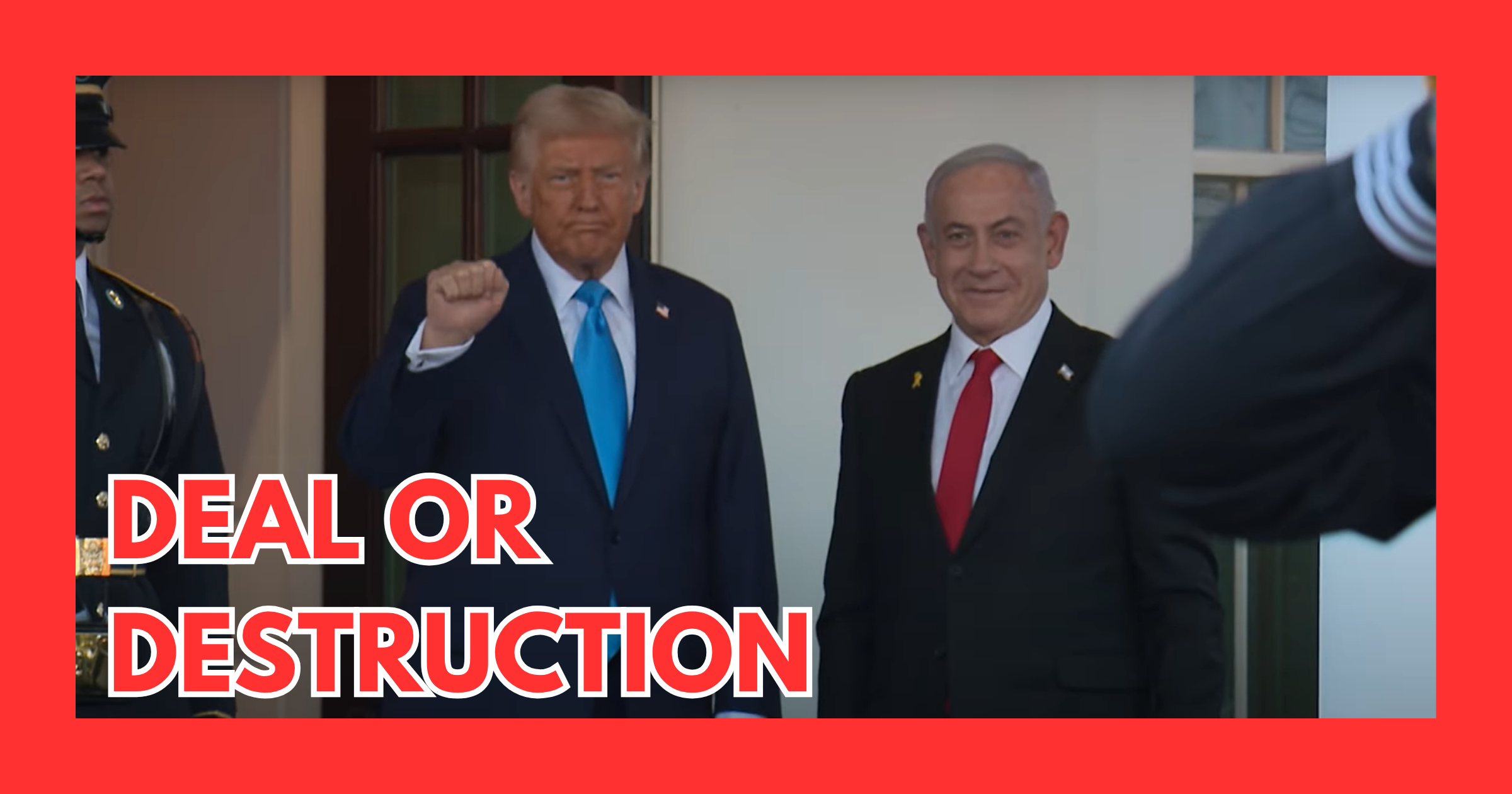
Video: President Trump greets the Prime Minister of Israel — from The White House, licensed under CC BY 3.0 US.
Deal or Destruction: The Ultimatum Trump Issued, the Strike Netanyahu Executed, and the Retaliation Iran Just Launched
The rhetoric is over. The retaliation may just be beginning.
by Met Middleson
June 13, 2025
A deadline was set. A strike followed. And now a second front is opening in real time. What began as a diplomatic warning from President Trump has turned into a live regional conflict, with Israel’s jets in the sky, Iran’s missiles in the air, and the world watching what comes next.
TENSIONS, LONG BEFORE TRIGGERS
The current escalation did not begin with a deadline or a drone strike. It is the latest chapter in a decades-long standoff shaped by weapons, warnings, and shifting alliances.
Since the 1979 Islamic Revolution, Iran has viewed both the United States and Israel as existential adversaries. It has long denounced the United States as the “Great Satan” and Israel as the “Little Satan.” The United States, in turn, has designated Iran a state sponsor of terror since 1984, citing its support for militant groups across the Middle East.
Israel’s concerns have centered on Iran’s nuclear ambitions. Beginning in the early 2000s, Israeli intelligence flagged covert enrichment efforts. That triggered waves of diplomacy, sabotage operations, and cyberattacks, most notably the Stuxnet virus in 2010. The 2015 Iran nuclear deal, known as the JCPOA, temporarily slowed uranium enrichment. But President Trump withdrew the United States from the agreement in 2018, reigniting tensions.
In the years since, Iran has accelerated its enrichment program. Israel has stepped up covert strikes. The United States has shifted from diplomacy to pressure. The lead-up to this moment was not quiet. But it was the introduction of a fixed timeline and a missed deadline that changed what followed.
TRUMP’S 60-DAY ULTIMATUM
In early April, President Trump’s administration issued a message to Tehran through intermediaries. Halt nuclear enrichment and come to the table or face consequences. The ultimatum was not formalized in a treaty or press release. Instead, it was echoed in closed-door briefings and later delivered publicly in Trump’s signature style, online and absolute.
On June 13, hours after Israeli forces launched strikes deep inside Iran, Trump posted, “Two months ago I gave Iran a 60-day ultimatum to ‘make a deal.’ Today is day 61. They didn’t make it. Now they have, perhaps, a second chance.” The timing of the message reframed the airstrikes not as a provocation, but as the consequence of a missed opportunity.
By positioning the deadline as real and already expired, Trump turned a stalled negotiation into political cover. He offered no clear pathway back to diplomacy, only a vague suggestion that Iran might still act. The emphasis, however, was on what had already happened. The countdown had ended. The strike had landed.
NETANYAHU’S STRIKE TIMING
Just before dawn on June 13, Israel launched Operation Rising Lion, a coordinated pre-dawn assault across Iran. The strikes targeted major nuclear enrichment facilities including Natanz, along with ballistic missile production sites and research centers tied to uranium weaponization. Reports indicate senior military figures and nuclear scientists were killed.
In a nationally televised address on the same day, Prime Minister Netanyahu framed the operation as a necessary, morally justified action to counter an existential threat. He thanked President Trump by name, crediting him with moral clarity and strategic backing.
Netanyahu emphasized that the strike was based on robust intelligence and was part of a sustained campaign, not an impulsive decision. While he did not mention Trump’s 60-day ultimatum, the timing closely following Trump’s deadline suggests coordination rather than coincidence.
IRAN’S RESPONSE PROMISES
Iran’s retaliation is underway.
It began earlier today with a wave of more than 100 drones launched from Iranian territory. Israeli fighter jets intercepted the swarm before it could reach Israeli airspace, downing most of the UAVs over Iraq and Jordan. No damage was reported on the ground. The message was unmistakable, a first move, not the final one.
Now, missiles are being fired.
Sirens are sounding across Israel as Iranian ballistic missiles target cities and strategic locations. Israel’s air defense systems, including Iron Dome and Arrow batteries, are actively intercepting inbound threats. The military is urging civilians to remain sheltered as the situation develops in real time.
In a parallel strike, a long-range missile launched from Yemen by Iran-backed Houthi forces has hit Hebron in the West Bank, wounding five people, including children. It remains the only reported strike to land so far.
What began as a symbolic show of force is quickly turning into something more dangerous. And by all indications, it is not over.
RHETORIC AS STRATEGY
This conflict did not begin with a classified order or a diplomatic breakdown. It began in public, with speeches, social media posts, and carefully timed statements that signaled intent before a single missile was fired.
President Trump’s Truth Social posts were not policy memos, but they functioned like them. He spoke of a 60-day deadline. He declared Iran had failed to meet it. And just hours after Israeli jets struck Iranian nuclear sites, he posted again, framing the attack not as a provocation but as a predictable outcome. “They didn’t make it,” he wrote. “Now they have, perhaps, a second chance.”
Prime Minister Netanyahu’s rhetoric followed the same pattern. His speech invoked history, morality, and existential stakes. He cited Iran’s chants of “Death to America” and “Death to Israel.” He warned of a second Holocaust. And he thanked Trump personally, crediting the American president with helping shape Israel’s response.
Iran, too, has chosen its words carefully. Its officials are not just promising retaliation. They are broadcasting it. Military channels refer to martyrs, the Zionist regime, and the full weight of resistance. The language is absolutist. The consequences are unfolding live.
THE ESCALATION MODEL
What is unfolding now may not be just a military exchange. It appears to reflect a model where timelines are public, outcomes are suggested, and consequences follow without formal agreements.
Trump’s 60-day ultimatum was never part of a signed deal. But after the deadline passed, Israel struck. The order of events has raised questions about whether this approach could shape future policy. In a world where diplomacy plays out in public and warnings are issued in real time, the space between rhetoric and action seems to be narrowing.
Netanyahu framed the operation through historical and moral language, emphasizing the need to act before it was too late. Iran is now answering with its own message, carried through both statements and force. The concern is not only about the risk of wider conflict, but about the possibility that this pattern of rhetoric, deadline, and strike could become standard.
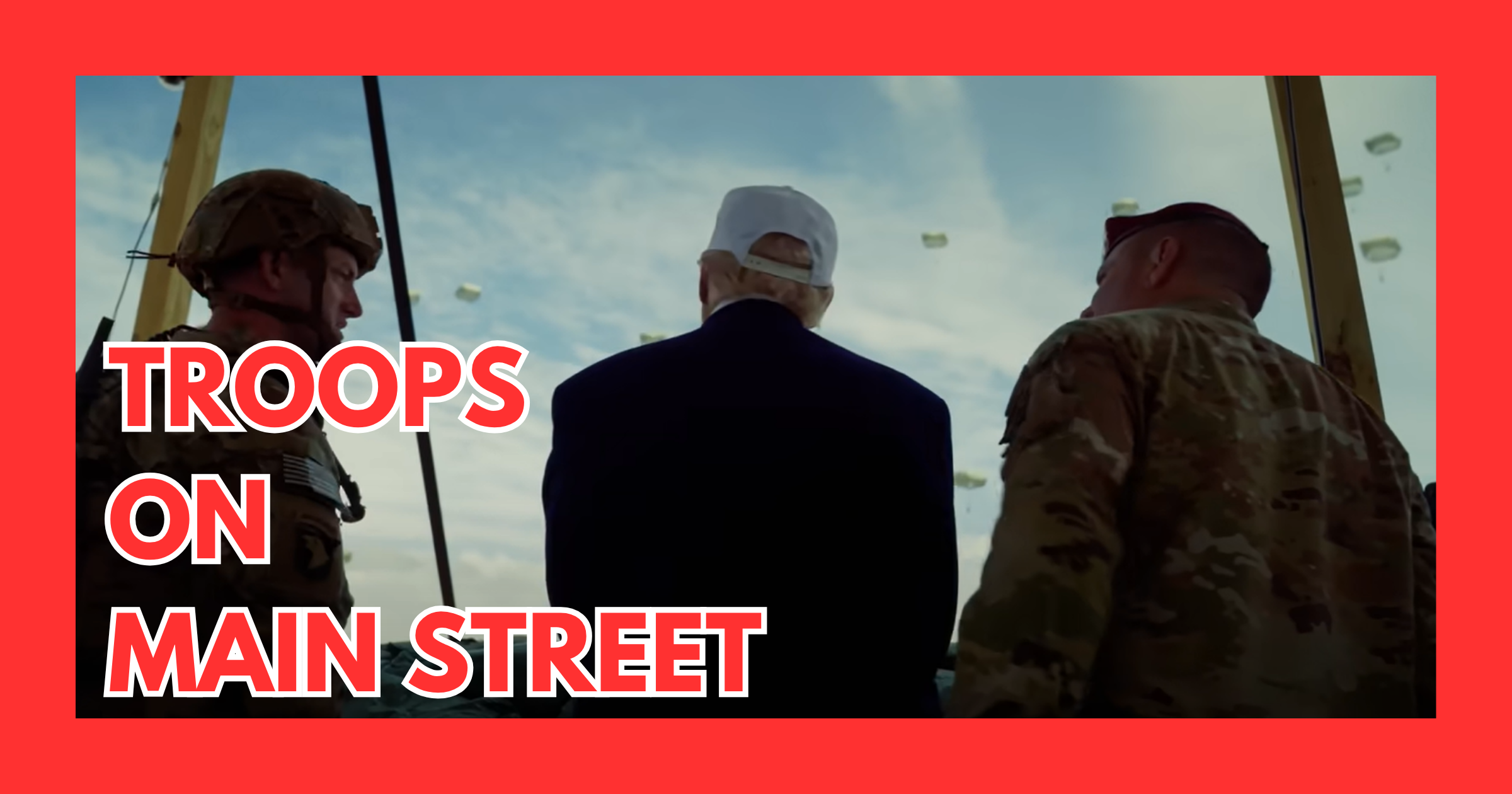
Image Credit: The White House, President Trump Addresses Troops at Fort Bragg CC BY 3.0
Troops on Main Street: From Orchestrated Displays to Citywide Deployment and Parade Plans
The battlefield is no longer the boundary as uniforms move into the public square.
by Met Middleson
June 12, 2025
It began with a National Guard deployment to Los Angeles in response to unrest following immigration raids. That initial wave grew quickly, reinforced by Marines under federal and state coordination. Days later, Donald Trump took the stage at Fort Bragg, delivering a speech that blended military praise with political grievance. Now, preparations are underway for a military parade in Washington, D.C., positioned as both celebration and signal. Each step has been distinct. Together they suggest a shift in how military presence is used and how it’s perceived.
ON THE STREETS OF LOS ANGELES
Tensions flared after ICE raids sparked widespread protests and clashes, including assaults on federal agents in Los Angeles. The historic moment came when President Trump invoked Title 10 authority to federalize roughly 4,000 California National Guard troops under his command, marking the first such federalization without a governor’s consent since the 1960s.
That shift paved the way for the deployment of about 700 active-duty Marines from Camp Pendleton. These Marines joined the Guard on city streets to protect federal buildings and support crowd-control operations, marking an unusual military presence in an American urban setting.
High-profile arrests of individuals accused of violent offenses during ICE actions underscored the intensity of these operations. As federal troops moved in, state leaders led by Newsom challenged the deployment in court, arguing it represented a dangerous overreach.
Each wave added to the next. Protests turned violent, Guard troops were federalized, Marines hit the streets, and high-profile detentions followed. What began as state-managed support quickly evolved into a visible federal operation involving active-duty military, shifting the tone and optics of troop presence at home.
THE STAGE AT FORT BRAGG
At a formal event marking the Army’s 250th anniversary, President Trump addressed active-duty troops at Fort Bragg. During the speech, he praised military service while also criticizing several public officials, including California Governor Gavin Newsom and President Biden. Troops in the audience were heard cheering and booing in response.
According to internal planning documents reported by several outlets, soldiers positioned behind the president were screened in advance, with instructions focused on appearance and ideological alignment. Those who disagreed with the tone or content of the event were given the option not to attend.
In the same speech, the president described protests in Los Angeles as a foreign-style threat and suggested that military intervention may be necessary to restore order. He referenced the possibility of invoking the Insurrection Act and previewed a planned parade in Washington, D.C., where troops would take part in a public celebration of military strength.
No formal orders were issued during the event. The speech was delivered in uniformed surroundings, on a military base, to a screened audience of service members.
PREEMPTIVE POSTURE IN TEXAS
While the Los Angeles deployment responded to active unrest, Texas moved in anticipation of it. Days before planned anti-ICE protests, Governor Greg Abbott ordered more than 5,000 National Guard troops and 2,000 state troopers to strategic positions across major cities. The action was framed as a preventive measure to deter disruption, with forces instructed to assist in keeping the peace.
The deployment did not follow a specific emergency declaration, but it aligned closely with federal immigration operations already underway. Though not coordinated with the White House directly, the scale and language of the order reflected a familiar tone. Protest was treated not just as expression, but as a potential threat to be managed through a show of force.
PLANS FOR PARADE
The event in Washington, D.C. will mark the U.S. Army’s 250th anniversary, Flag Day, and President Trump’s 79th birthday. Organizers expect it to be the largest military parade in the capital since 1991, with approximately 6,600 troops, 150 ground vehicles including Abrams tanks, and 50 aircraft ranging from helicopters to historic warplanes.
Activities will begin with a morning wreath-laying at Arlington National Cemetery and continue through afternoon fitness challenges and equipment demonstrations. The parade is scheduled for 6:30 p.m. along Constitution Avenue, followed by a fireworks display. Security measures will include 18 miles of fencing, 175 metal detectors, airspace restrictions, and street closures throughout the downtown area.
The event is estimated to cost between 25 million and 45 million dollars, with additional funds set aside for vehicle transport and street repairs. Trump first called for a military parade after attending Bastille Day celebrations in France in 2017. A similar effort in 2018 was canceled due to budget concerns.
In advance of the parade, Trump stated that any demonstrations would be met with very big force. “No Kings” protests are expected in cities across the country, although none are currently planned in Washington.
A GROWING PATTERN
Over the span of days, the role of the U.S. military inside the country expands across multiple settings. Troops deploy in Los Angeles to respond to unrest. In Texas, the governor issues a preventive deployment of National Guard troops ahead of planned anti-ICE protests. Marines appear alongside the Guard on city streets in California. Soldiers stand behind the president during a political speech at Fort Bragg. And next, thousands more will march in a planned celebration along Constitution Avenue in Washington, D.C.
Each of these moments stands on its own, tied to specific events, emergencies, or commemorations. Taken together, they reflect a shift. The presence of troops is no longer limited to traditional defense or emergency response. It is increasingly visible, increasingly central, and increasingly symbolic.
From urban deployment to preventive posturing to political staging to national display, the military’s role in public life becomes harder to separate from the narratives surrounding it. The uniforms are not just showing up. They are being seen.
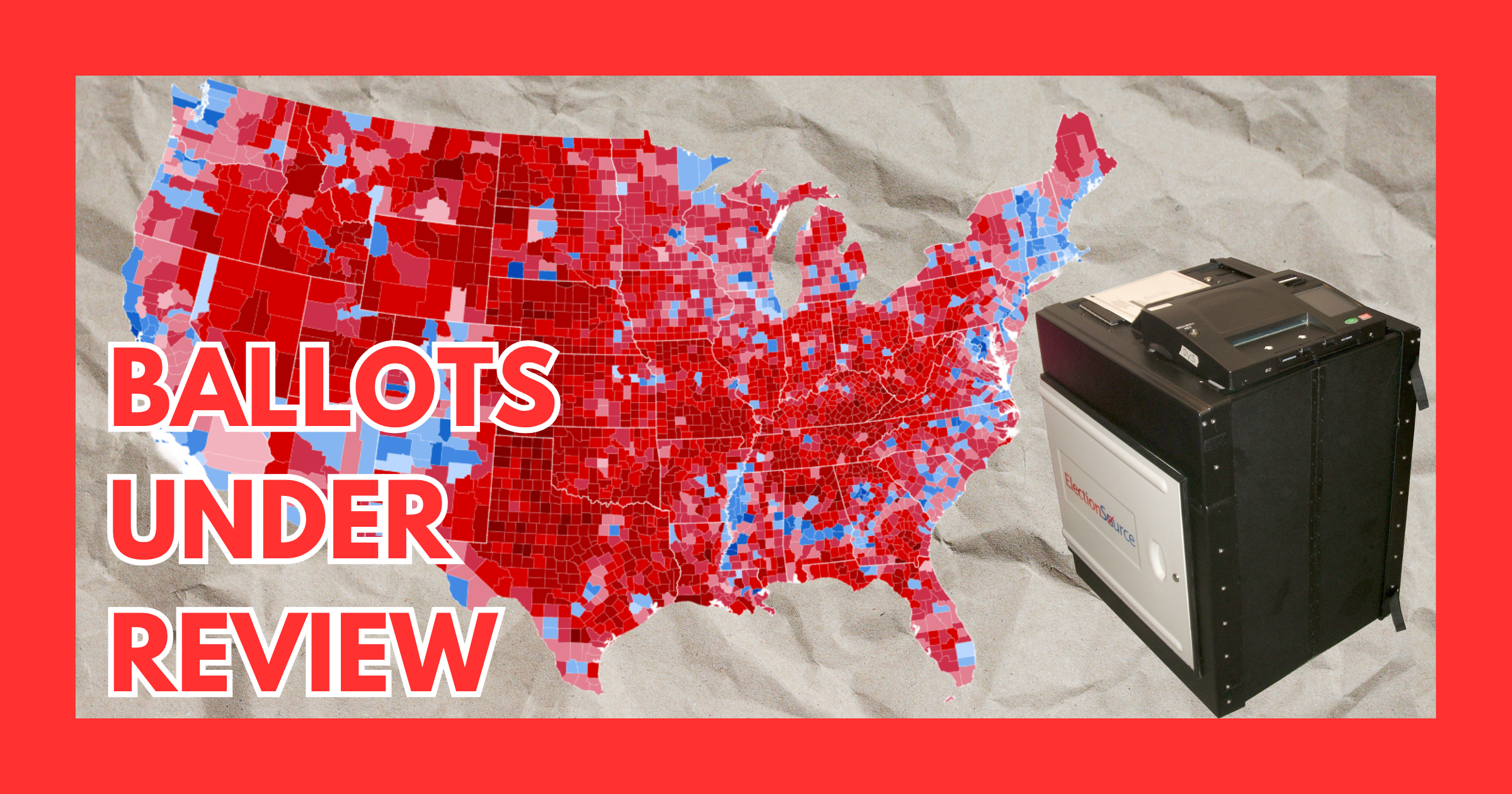
Douglas W. Jones, CC0, via Wikimedia Commons Born Isopod and voters of the United States of America, CC BY 4.0, via Wikimedia Commons


Ballots Under Review: Court Case Disputes 2024 Election Results
When the numbers didn’t add up, a judge told the state to look again.
by Met Middleson
June 11, 2025
It began with a statistical red flag: thousands of ballots in Rockland County’s 2024 election recorded a vote for president but no vote for Senate. That pattern proved statistically far from random, with undervote rates exceeding 30 percent in some Trump strong districts compared to normal levels elsewhere. Now a judge has ordered a hands-on review of those ballots, not just in the Senate race but including the presidential selections themselves.
VERIFIED DISCREPANCIES
The 2024 general election certified Donald Trump as the winner in Rockland County, New York, with 83,543 votes, a dramatic 11-point swing from 2020. Yet more than 15,000 ballots recorded no vote at all for the U.S. Senate race.
That total, 15,366 undervotes in the Senate race, amounted to just over ten percent of all ballots cast in Rockland County. Thousands of voters selected a presidential candidate but left one of the most prominent races on the same ballot line blank. According to SMART Elections, the drop-off pattern was unusually concentrated in certain districts and statistically inconsistent with expected voter behavior. Their analysis suggests that Senate undervotes were more common in areas where Donald Trump performed strongly, raising questions about whether machine misreads selectively failed to capture down-ballot votes.
By contrast, drop-off rates in historically Democratic districts were lower and more consistent with past elections. The largest anomalies clustered in Republican-leaning precincts, suggesting the possibility that down-ballot selections were misread or misrecorded even as presidential choices were properly tallied.
Further evidence came from Senate candidate Diane Sare. In two districts voters submitted affidavits swearing they voted for her, yet the official tally listed fewer Sare votes than sworn statements. In ED 39 nine affidavits were filed while the certified count showed five Sare votes. In ED 62 five voters testified, but the count showed three.
These are not abstract claims; they are sworn statements matched to real ballots. Together they raise the prospect that the tabulation process failed to register certain selections beyond the Senate race, potentially affecting other contests on the same ballot.
SYSTEMIC PATTERNS AND DROP-OFF LOGIC
The ballots in question were all processed through Dominion ImageCast scanners. These machines read selections across the entire ballot, from president to local judgeships. But in Rockland County’s 2024 general election, the machines consistently reported complete presidential selections followed by missing entries for U.S. Senate and beyond.
That pattern appeared at scale. Of the more than 15,000 ballots that skipped the Senate race, most had a valid presidential vote. In precinct after precinct, voters selected Trump or in fewer cases Harris, but appeared to skip every other contest. Statistically, that level of drop-off is rare. Even in low-profile races, some residual vote activity typically remains. Here, large blocks of ballots show a clean top-line vote followed by silence.
Election integrity advocates point out that high undervote rates can signal either voter intent or machine behavior. In this case, the consistent undervoting aligned more with geographic clusters than with demographic expectations. Districts with higher Trump support were more likely to show extreme drop-off between the presidential and Senate races, while districts with tighter margins showed more typical vote patterns.
This matters because all races on the ballot are recorded from the same scan. A machine error that misreads one contest could affect the others. While there is no confirmed evidence that presidential votes were lost, the lawsuit argues that the failure to verify results from any part of the ballot raises concerns about the accuracy of the whole.
LEGAL RESPONSE AND DISCOVERY STATUS
New York Supreme Court Justice Rachel Tanguay ruled that the case presented by SMART Elections and its co-plaintiffs could proceed to discovery. Her order was based on specific allegations backed by voter affidavits, certified result comparisons, and documented undervote statistics.
The plaintiffs are not alleging widespread fraud. Their claim centers on the argument that Rockland County’s Board of Elections certified results that failed to reflect the true intent of voters. They point to machine misreads, undervote anomalies, and the Board’s refusal to allow a recount or full ballot inspection despite formal requests and testimony from affected voters.
Under New York law, parties to an election challenge can request discovery when they show reasonable grounds for concern. In this case, the court found the evidence credible enough to require the Board of Elections to release machine logs, scanner records, ballot images, and related documentation.
The legal action seeks no reversal of election winners. It asks for a full hand count of ballots in the affected districts and a public accounting of any discrepancies between machine tabulations and the physical vote. If differences are confirmed, the plaintiffs say the county’s certification process may need procedural reform, particularly in cases where voter testimony conflicts with machine output.
As of this writing, subpoenas have been issued, deadlines are pending, and the court has not placed limits on which parts of the ballot may be reviewed. That includes the presidential race.
ELECTION PROCEDURES UNDER SCRUTINY
For Rockland County officials, the 2024 election was certified without incident. Machines reported totals. Tallies were transmitted. No recount was triggered, and no audit was performed. But the court’s decision to allow discovery has turned a routine certification into a case study in how election procedures respond, or fail to respond, when numbers are contested by the public.
New York does not require an automatic hand recount unless the margin between candidates is razor thin. It also does not mandate that undervotes or blank contests be investigated unless formally challenged. That leaves gaps in oversight, especially when undercounts are not spread evenly but instead cluster in certain precincts or among specific races on the ballot.
In this case, the plaintiffs allege that voters were disenfranchised not by fraud or suppression, but by a system that refused to double-check itself. They argue that sworn affidavits from voters should have triggered a review, and that the Board of Elections’ refusal to provide ballot images or scanner logs limited their ability to prove the discrepancy.
The court has not ruled on whether those claims are accurate. But by granting discovery, it opened the door for those records to be examined and for the procedures that blocked a recount to be tested in full public view.
WHAT COMES NEXT
The court’s discovery order puts Rockland County’s 2024 ballots, scanners, and certification procedures under formal review. The Board of Elections is now required to provide machine logs, ballot images, and other records that could confirm or contradict the plaintiffs’ claims.
If those records show that votes were miscounted, skipped, or dropped from the certified results, it may not change the outcome of any race. But it would challenge the assumption that certified results always reflect voter intent, and could lead to legal or legislative pressure for stronger recount protocols in future elections.
For now, the case continues. No findings of fraud or machine malfunction have been made. But one fact is no longer in dispute. A New York judge found the evidence credible enough to look again.
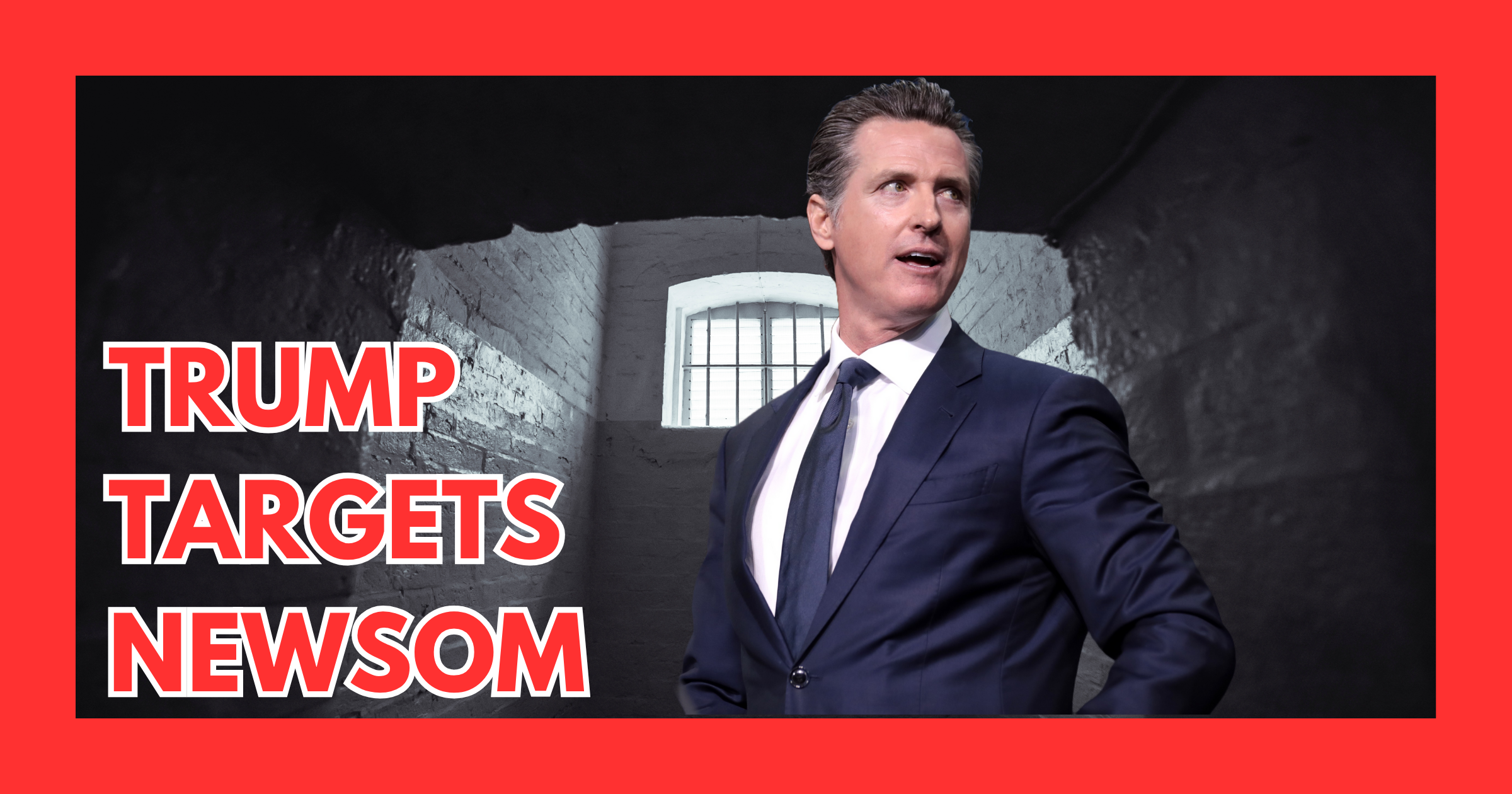
“Gavin Newsom” by Gage Skidmore is licensed under CC BY-SA 2.0 

 .
.
Trump Targets Newsom: Why Threats to Arrest a Governor Reach Beyond California
Calls for Newsom’s arrest have moved from fringe to federal. What happens next could reshape the limits of executive power.
by Met Middleson
June 10, 2025
Gavin Newsom is no stranger to political attacks. But in recent days, the rhetoric from the Trump administration has shifted into something more serious and more dangerous. Federal officials have floated the idea of arresting California’s governor. Trump has amplified it. House Speaker Mike Johnson went further, suggesting Newsom deserved to be “tarred and feathered.” And with National Guard troops deployed to Los Angeles without the state’s consent, what began as a political clash is now raising legal alarms about power, precedent, and the future of executive authority.
A GOVERNOR UNDER ATTACK
The attacks on Gavin Newsom have moved beyond politics. Donald Trump has repeatedly referred to him as “Newscum,” blamed him for unrest in Los Angeles, and mocked him in speeches and posts to millions of followers. In a Truth Social post, Trump suggested that Newsom’s policies had directly caused “catastrophic riots,” and he praised ICE’s Tom Homan for suggesting Newsom could be arrested. Trump’s response: “I would do it if I were Tom… it would be a great thing.”
The escalation didn’t stop there. Speaker of the House Mike Johnson publicly stated that Newsom should be “tarred and feathered” for defying federal immigration orders. Taken together, these statements are no longer just rhetorical jabs. They signal a shift in posture from disagreement to dehumanization, and from criticism to criminalization.
FROM FEUD TO FORCE
The political feud escalated into federal action when Trump ordered the National Guard into Los Angeles without a formal request from the state. Newsom called the move illegal and immediately filed a lawsuit, accusing the administration of abusing emergency authority to seize control of California’s military forces. The federalized Guard was deployed to “restore order” following protests, but Newsom argues the decision bypassed state leadership and violated both legal norms and constitutional protections.
At the same time, Trump intensified his rhetoric online, describing the protests as “insurrection” and mocking mask-wearing demonstrators. He warned that “troublemakers will be hit harder than they’ve ever been hit before,” while celebrating the Guard’s presence as a success. Newsom, in contrast, described it as “political theater designed to provoke” and warned that using federal troops as a tool of personal retribution sets a dangerous precedent.
THE POLITICS OF ARREST
Calls for Newsom’s arrest began as fringe chatter, but they’ve steadily climbed the ranks of official discourse. Tom Homan, Trump’s border czar and head of Enforcement and Removal Operations at ICE, publicly speculated that Newsom and Los Angeles Mayor Karen Bass could face prosecution for interfering with federal immigration enforcement. Trump amplified the statement, calling it “a great idea” and suggesting Homan should “follow through.”
Even without legal grounding, the threat alone changes the tone of debate. It signals that challenging federal power might come with personal risk.
That message became even clearer when federal agents arrested Wisconsin Judge Hannah Dugan earlier this year. Prosecutors allege she helped an undocumented defendant avoid ICE detainment by coordinating his release through a courthouse back entrance. While Dugan and her defenders argue she was following judicial discretion, the case marks a sharp escalation that moves the idea of criminalizing defiance from theory to precedent. For officials like Newsom, it raises a new question: if a judge can be arrested for a courtroom decision, what’s stopping a governor from facing the same?
POWER WITHOUT PERMISSION
At the center of the legal standoff is the federalization of California’s National Guard. Trump sent troops into Los Angeles without a request from Governor Newsom, a move that Newsom’s legal team calls unconstitutional. The lawsuit argues that the president invoked emergency powers not to restore order but to override political opposition.
While the White House insists the move was necessary to respond to “growing unrest,” Newsom contends the deployment was never about public safety. He points out that neither the state nor city leaders asked for assistance, and that the timing of the action came just hours after his administration announced it would not cooperate with ICE-led raids. To Newsom, the message is clear: disobedience brings consequences.
THE GOVERNOR’S GAMBLE
Newsom’s response has been defiant. Rather than deescalate, he has leaned into the confrontation, filing a lawsuit, speaking out in national interviews, and directly challenging Trump’s authority. “Arrest me? Let’s go,” he wrote in one post. In another, he called Trump’s actions “the stuff of authoritarian regimes” and warned that federal overreach like this threatens not just California but every state.
By casting the conflict as a test of democratic boundaries, Newsom is betting that public support will follow a clear stand against federal intimidation. But the risks are real. If the legal challenge fails or the administration escalates further, he may find himself isolated, not just politically but operationally.
He is not the only one to test this line. When Harvard refused to comply with new federal directives on campus speech and foreign disclosure, the Trump administration responded by suspending its federal research funding and launching multiple investigations into its operations. The message was unmistakable. Resistance can be met with total isolation. For Newsom, the risk is not just legal defeat. It is watching the machinery of federal power turn inward on his state, the way it already has on others.
THE STAKES BEYOND CALIFORNIA
The clash between Trump and Newsom may feel personal, but the implications are institutional. What happens next could set the tone for how far a president can go in using federal power against state officials. If the threats of arrest become a normalized part of executive messaging, or if military deployment without consent becomes a tested, unchallenged tool, the impact will reach far beyond California.
Governors in other states are watching closely, including those who may agree with Trump’s policies. Because today it is Newsom. Tomorrow it could be any official who defies federal command, whether on immigration, education, or public safety. The real question is not whether this fight ends with a lawsuit. It is whether the presidency itself now comes with a license to punish dissent.
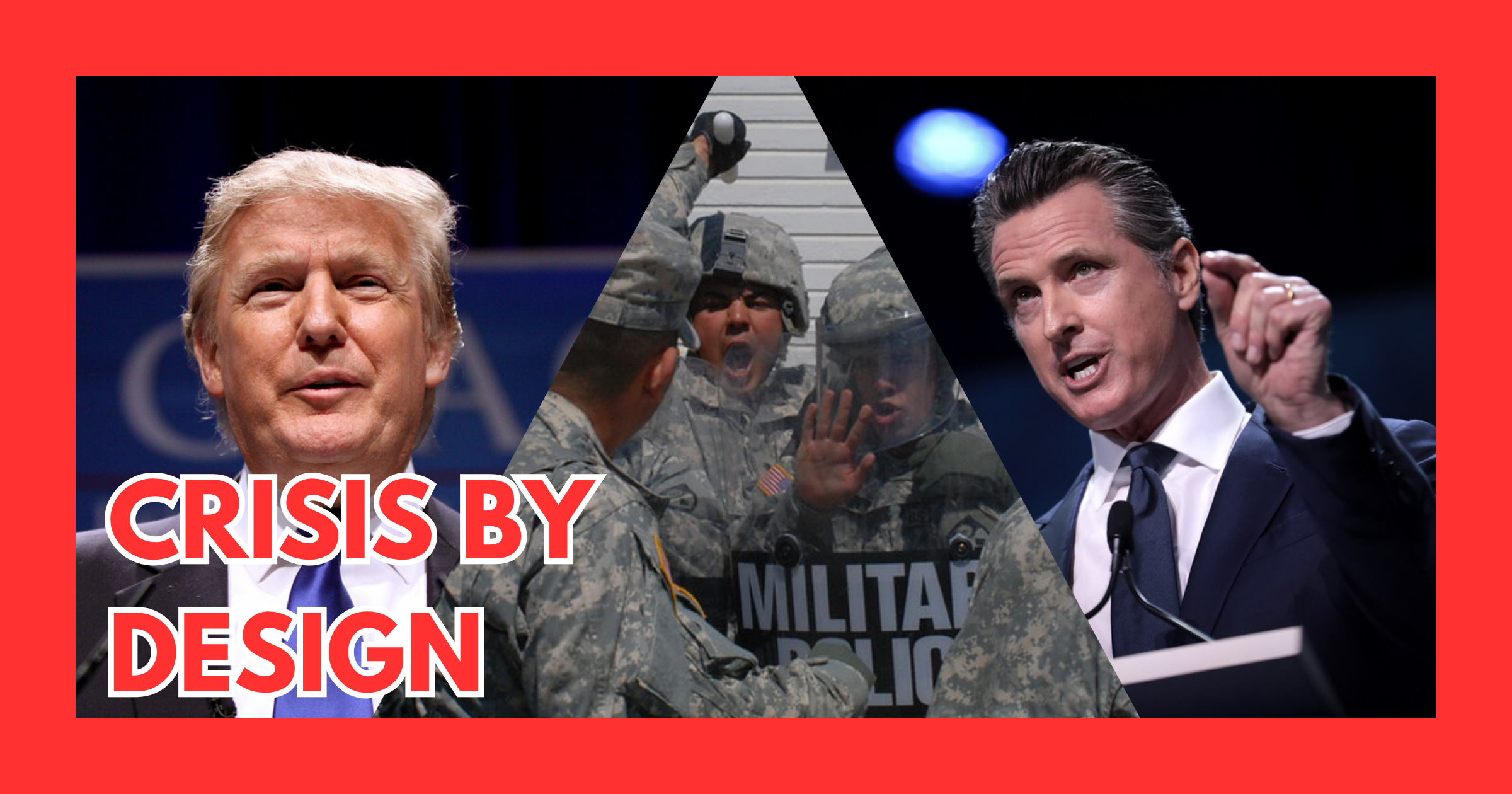
“Donald Trump” by Gage Skidmore is licensed under CC BY-SA 2.0 .
“California National Guard military police conduct law enforcement and leadership training” by Like us on Facebook at CAGuard is licensed under CC BY 2.0 .
“Gavin Newsom” by Gage Skidmore is licensed under CC BY-SA 2.0 .
Crisis by Design: Trump Frames ICE Protests as Migrant Uprising to Justify Military Response
Troops are on the streets. The reason why keeps changing.
by Met Middleson
June 9, 2025
Los Angeles is on edge. National Guard troops are patrolling the streets. Protesters have clashed with police, lit fires, and blocked highways in response to a sweeping series of ICE raids across the city. While law enforcement has described the crowds as “mostly peaceful,” the White House is telling a different story. President Trump has labeled the unrest a “migrant insurrection,” sent 2,000 federally controlled guardsmen, and warned of further force to come. His justification hinges on the idea of a foreign-led uprising, but most of the footage shows American citizens holding signs, not crossing borders. That dissonance raises a larger question: If the violence doesn’t explain the response, what does?
BURNING CARS, BROAD STROKES
There has been real violence in Los Angeles. Cars have been torched, storefronts vandalized, and police officers attacked with bottles and fireworks. Streets have been blocked, buildings evacuated, and tensions have flared into full confrontation in several neighborhoods. In some cases, protesters reportedly threw concrete at ICE agents and federal officers, and at least one Molotov cocktail was hurled during a confrontation outside a detention facility. The images are gripping and chaotic. They dominate headlines for a reason.
But those images, while undeniable, are not the whole picture. Much of the city has seen peaceful demonstrations. Crowds have included families, students, and longtime residents marching without violence. Protesters have gathered near detention centers, blocked traffic in organized waves, and delivered speeches denouncing the raids without crossing into destruction. Those acts of violence, while real, occurred alongside thousands of peaceful demonstrators who did not engage in any form of destruction or assault. The LAPD itself has acknowledged that., describing the protests as “largely peaceful” in official briefings.
That distinction has not carried over to the national stage. In the president’s telling, the city is overrun, the crowds are criminal, and the unrest is an imported threat. A handful of violent acts have been stretched to fit a broader narrative that demands force in response.
FROM DISSENT TO “MIGRANT RIOT”
President Trump has repeatedly escalated the language around the Los Angeles protests on Truth Social and X. He has called them a “migrant invasion.,” demanded the city be “liberated” from it, warned of “migrant riots,” condemned “insurrectionist mobs,” and even posted “They spit, we hit” before labeling the participants “paid insurrectionists.” This is not casual rhetoric. It is a deliberate reframing that positions dissent as a foreign-led rebellion and primes the public to view federal force as necessary rather than extraordinary.
Most protestors appear to be U.S. residents. Many are long-time Californians and participants in local activist movements. While the crowd is diverse, there is no clear evidence that the protests are being driven by undocumented migrants. Yet by labeling the unrest a migrant-led uprising, Trump invites his audience to see the demonstrations as foreign, unlawful, and disloyal. That framing shifts the lens just enough to make military escalation feel like protection instead of suppression.
This approach is nothing new. Trump has repeatedly blurred the lines between immigration, protest, and public safety. He has portrayed sanctuary cities as crime havens, border crossings as security threats, and dissent as disloyalty. By linking immigration to violence and violence to disobedience, he sets the stage for federal force as an act of patriotism. The potential goal may not be to explain what is happening, but rather to define who counts and who doesn’t.
IMMIGRATION: THE TOP-POLLING TRIGGER
For years, immigration has been one of Donald Trump’s most powerful political tools. It polls as his most trusted issue across nearly every major survey, and no matter how many times it surges or fades in the news cycle, it remains a reliable rallying point. In this moment, the images coming out of Los Angeles offer him exactly what he needs. They are emotional, easy to frame, and difficult to fact-check in real time.
Trump is not just responding to events. He is using them. The deployment of the National Guard reinforces his role as enforcer, not negotiator. The terminology he uses, including “migrant riot,” “insurrection,” and “invasion,” is not built to describe policy or offer detail. It is built to stir reaction. And it does. Polling shifts after each high-profile incident suggest that public opinion tends to harden in his favor when the imagery matches the narrative. Violence in the streets, even when isolated, becomes confirmation of everything he warned about.
For those who support stronger immigration enforcement, this moment is not just about strategy. It is about symbolism. The image of Trump standing against a lawless, chaotic California fits the mold perfectly. It is not a coincidence that immigration continues to rise in his stump speeches, press posts, and policy proposals. It works. And this week, it is working again.
THE CALIFORNIA TARGET: GAVIN NEWSOM’S SHADOW
California has long been more than just a policy rival to Trump. It is a symbol. With its sanctuary laws, progressive climate mandates, and frequent legal challenges to federal authority, the state has become a recurring antagonist in Trump’s political playbook. But this week’s federal response raises the conflict to a new level. This time, California is not just a rhetorical punching bag. It is a stage.
Governor Gavin Newsom has emerged as one of the most visible critics of Trump’s second‑term agenda and is widely speculated to be a leading Democratic contender for the presidency in 2028. He has condemned the federal deployment of troops, questioned its necessity, and accused the administration of escalating tensions rather than easing them. In a post on X, Newsom asserted that Trump “sent 2,000 National Guard troops into LA County — not to meet an unmet need, but to manufacture a crisis.” This framing suggests that the real purpose of the deployment may lie in message-making more than in security.
That contrast still benefits Trump. He does not need to win California, and he is not running again. But he is shaping the battleground for whoever comes next. The more chaotic California appears, the more any future Trump-aligned candidate can point to it as a cautionary tale. In that framing, Newsom is not just a critic. He is the future they are warning against.
STATE RIGHTS, FEDERAL FORCE
The deployment of National Guard troops into Los Angeles was carried out without notice to California’s governor. Governor Newsom has called the move “illegal” and a breach of state sovereignty. This was not a coordinated or requested state response. Trump invoked federal authority under Title 10 to federalize the Guard, effectively overriding the state’s command and placing troops under direct federal control. That move happens rarely and only in extreme cases.
Federally activating a state’s own troops without its approval has not happened since 1965, when President Johnson sent forces to enforce school desegregation in Alabama. It was used again in 1992 during the Los Angeles riots after the Rodney King verdict, but that followed a complete breakdown of civil order and a formal emergency request. Here, the LAPD continues to describe the protests as “largely peaceful,” and no such request was made.
The decision to bypass state consent transforms the deployment into something more than a security measure. It becomes a statement about who gets to call the shots and why.
That shift carries implications beyond California. If the president can override state authority based solely on his own framing of unrest, the line between law enforcement and political theater begins to fade. And when force becomes a narrative tool, the danger is not just constitutional. It is cultural. A country begins to look different when consent no longer determines who shows up in uniform.
PROVOCATION OR POLICY?
The federal deployment in Los Angeles is being described as a response to unrest. But every element of the response—the language, the imagery, the timing—also serves another function. It elevates the moment. It dramatizes the threat. And it places the president squarely at the center of it.
This is not the first time. From border surges to urban protests, past moments of unrest have often become platforms for broader messages. They generate headlines. They frame opponents. They reinforce the idea that order requires force. Whether that outcome is intentional or not, the result is the same. The crisis becomes content. The action becomes identity. And the cycle continues.
What is unfolding in Los Angeles is more than a protest and more than a deployment. It is a test of lines between state and federal power, between dissent and threat, and between leadership and performance. The pictures may fade, but the precedent is being set in real time.
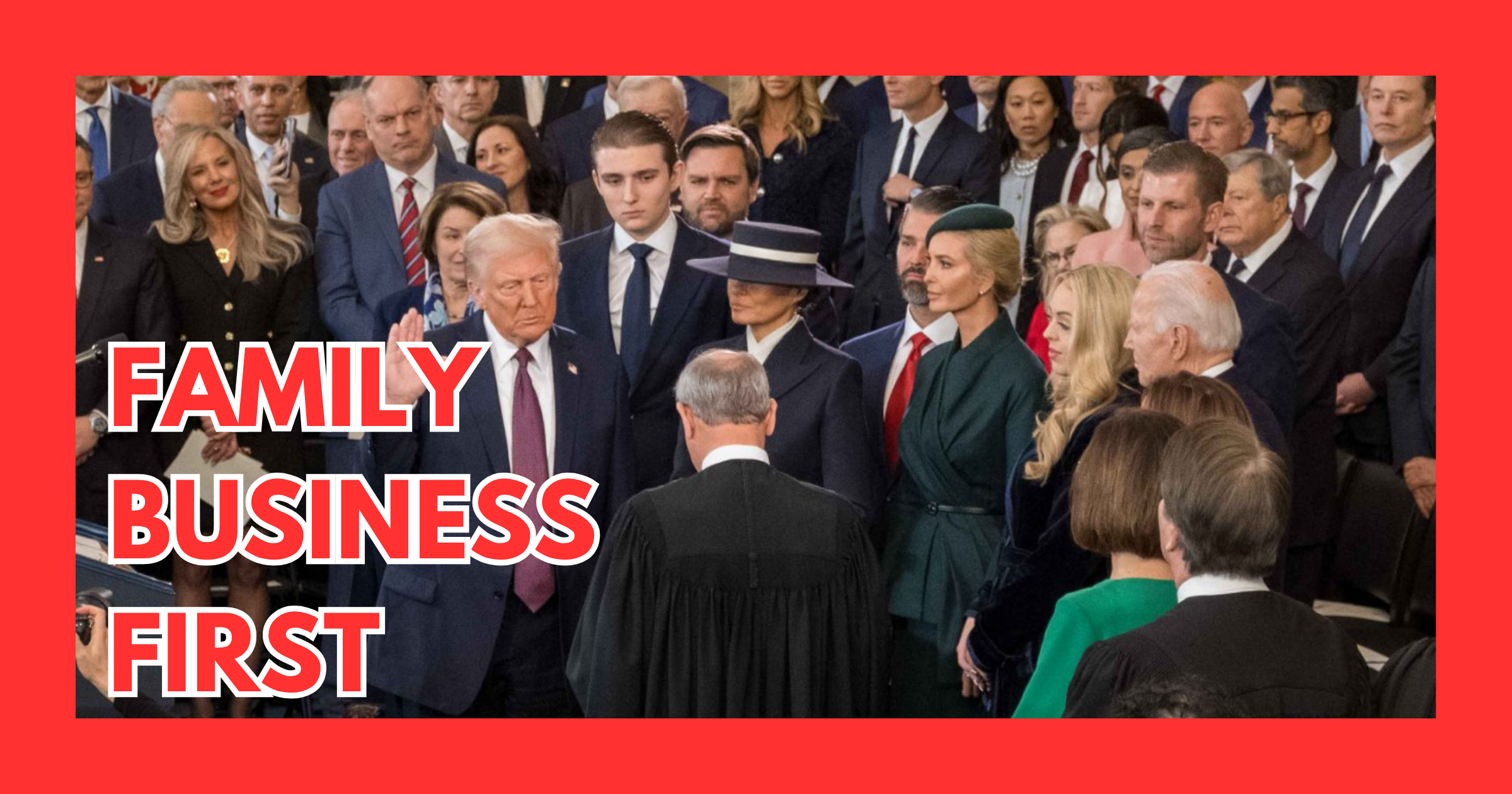
Joint Congressional Committee on Inaugural Ceremonies – Public domain, via Wikimedia Commons
_(cropped2).jpg)
Family Business First: How the Big Beautiful Bill Guts States’ Rights to Regulate the Trump Family’s Newest Investments
President Trump may be backing this bill with everything he has because his family’s future is written into it.
by Met Middleson
June 8, 2025
Just months before the debut of the One Big Beautiful Bill, two of Donald Trump’s children quietly entered the artificial intelligence arms race. Backed by a Wall Street holding company with ties to digital infrastructure, Donald Trump Jr. and Eric Trump invested in American Data Centres Inc., a private venture focused on building AI and crypto-friendly facilities across the United States. At the same time, President Trump was preparing to launch a sweeping legislative package that would cement federal control over the AI economy, strip state governments of regulatory authority, and unlock hundreds of billions in public and foreign-backed infrastructure funding. The bill may be positioned as a national strategy. But its terms align closely with the business interests of the president’s own family.
THE FAMILY POSITIONED
On February 18, 2025, Dominari Holdings, a publicly traded company based in New York, announced the launch of American Data Centres Inc. The firm, backed in part by Donald Trump Jr. and Eric Trump, plans to construct high-efficiency data infrastructure across the country, targeting both artificial intelligence compute power and cryptocurrency mining. According to SEC filings and company press releases, the venture is positioning itself to take advantage of national momentum around artificial intelligence and the demand for power-intensive server facilities.
In late March, just weeks before the One Big Beautiful Bill was introduced in Congress, American Data Centres announced a new strategic partnership with a crypto infrastructure firm, expanding its footprint while maintaining its focus on AI. At the same time, President Trump was preparing to unveil a sweeping legislative package that included tax incentives, federal zoning directives, and artificial intelligence deregulation measures designed to accelerate infrastructure development. Among the bill’s most controversial provisions was a ten-year ban on state-level AI regulation. That language may directly benefit companies like American Data Centres by shielding them from oversight in states like California, New York, and Virginia.
THE BIG BEAUTIFUL SELL
From the start, President Trump has pitched the One Big Beautiful Bill as a unifying leap into the future. In public remarks, he described it as a patriotic milestone, claiming it would unleash American genius and make sure no one, not China and not Europe, gets ahead of the United States in the artificial intelligence race. The bill was rolled out as a broad legislative effort to create jobs, modernize infrastructure, and solidify America’s position in a fast-changing global economy.
At a March meeting with the NATO Secretary General, Trump said, “We have the big, beautiful bill. We gotta get that done and that will put our country in a position like it’s never been in.” He framed the bill as a blend of tax reform, environmental incentives, and strategic dominance, calling it “great environmentally” and “tremendous” for attracting global investment. That messaging, repeated in speeches and social media posts throughout the spring, helped position the legislation as a generational achievement but omitted any mention of the bill’s impact on state authority.
When the House passed the bill on May 22, the White House released a statement calling it a once-in-a-generation opportunity to solidify the America First agenda. Days later, Trump took to social media, urging the Senate to move quickly. “Passing THE ONE, BIG, BEAUTIFUL BILL is a Historic Opportunity to turn our Country around,” he wrote. “Work as fast as they can to get this Bill to MY DESK before the Fourth of JULY.”
Missing from those speeches, statements, and social media posts was any reference to the nearly 1,200-page bill’s most far-reaching regulatory shift. A single provision blocks state and local governments from regulating artificial intelligence for ten years. That moratorium applies not just to software models and consumer-facing tools but to physical infrastructure such as data centers, power systems, and water-intensive computing hubs that states have only recently begun to scrutinize. The bill’s language shifts all authority to the federal level, effectively cutting governors, state legislators, and local agencies out of the conversation for the next decade.
THE CLAUSE THAT SILENCES
Buried on pages 278 and 279 of the One Big Beautiful Bill is a clause that rewrites the balance of power between the federal government and the states. The language prohibits any state or local government from creating, enforcing, or modifying laws related to artificial intelligence for a period of ten years following the bill’s enactment. The restriction applies broadly, not just to software or algorithms but to any system, process, or infrastructure involving machine learning, neural networks, or automated decision-making.
Legal analysts and technology policy groups have raised alarms over the scope of the clause. It effectively overrides state laws already on the books in places like Colorado, Illinois, and California, which have passed rules addressing bias in hiring algorithms, biometric surveillance, and deepfake political content. It also halts the development of pending legislation in more than a dozen other states. The freeze extends beyond digital tools to the infrastructure that supports them, potentially blocking states from regulating the power use, water consumption, zoning, and environmental impact of large-scale AI data centers.
At the federal level, no comprehensive artificial intelligence regulatory framework currently exists. With the passage of this bill, the federal government would hold exclusive authority without any clear roadmap for how that authority will be used. Critics argue the result is a vacuum, one that protects early movers and well-positioned private firms while sidelining the states and localities most directly impacted by AI’s expansion.
A STRUCTURE BUILT TO BENEFIT
The timing of the bill’s release is raising questions not only about federal authority but about who stands to benefit from the regulatory vacuum it creates. With state governments unable to act, infrastructure projects that would have once required extensive review now face a single point of federal approval. For companies with strong political ties or pre-positioned partnerships, that creates a significant advantage.
Among those positioned to gain is American Data Centres Inc., the infrastructure firm backed by Donald Trump Jr. and Eric Trump. The company’s business model depends on the rapid construction of high-powered data centers that support artificial intelligence, cryptocurrency, and cloud operations. In states like Virginia, California, and New York, environmental review boards are raising concerns about water usage, electricity demand, and zoning strain from AI-driven infrastructure. Under the new bill, those concerns no longer fall under state jurisdiction.
Other Trump-aligned ventures may also benefit. The Stargate initiative, announced by President Trump in January, includes partnerships with Oracle, OpenAI, and foreign-backed infrastructure funds seeking to build AI campuses on U.S. soil. The federal ban on state interference may streamline those projects just as new federal energy waivers, land access programs, and tax incentives begin to roll out. Whether intentional or not, the legislative landscape is shifting in a direction that favors early insiders and consolidates control under the Trump administration in Washington.
THE STATE-LEVEL REVOLT
The AI moratorium clause did not go unnoticed for long. Days after the bill passed the House, Representative Marjorie Taylor Greene announced a sudden and public reversal. Known for her unwavering loyalty to President Trump and for gaining political traction by aligning herself closely with his agenda, Greene surprised many of her own supporters by turning against one of his signature legislative efforts. In a post on X, she admitted she had not read the full 1,200-page text and said she would have voted no had she known about the language on pages 278 and 279. “Full transparency,” she wrote. “I did not know about this section… This is a violation of state rights, and I will not support it in the final version.” She later doubled down in a committee hearing, stating clearly that she would vote no if the clause remained.
Her shift gave political cover to a growing list of state and local leaders who are voicing concern. Governors in California, Illinois, and Washington have called for the provision to be removed. Attorneys general from both parties are warning that the ban would undercut existing enforcement tools and preempt laws passed by elected legislatures. Even Elon Musk, a former supporter of Trump’s early tech agenda, called the moratorium short-sighted and reckless, adding that it invites abuse.
In response to the backlash, Senate Republicans have floated alternatives that would tie compliance to federal broadband funding rather than impose a blanket preemption. But so far, the House language remains unchanged. And with the White House pushing for a swift reconciliation process, time is running out for state leaders to assert any control over how artificial intelligence expands inside their borders.
THE STAKES
Artificial intelligence is evolving faster than most institutions can respond. That pace has created a regulatory vacuum, one that Congress is now attempting to fill. But the decision to sideline state governments for a full decade raises more questions than it answers. In industries where innovation moves quickly, local accountability has often served as a check on overreach. Removing that layer of oversight may speed up development, but it also concentrates power in fewer hands.
In this case, some of those hands belong to the family of the president who signed the bill. The overlap between private investment and public authority may not violate the letter of the law, but it places the entire effort under a shadow of self-interest. At minimum, it changes the conversation. This is no longer just a question of national strategy. It is a question of who benefits when regulation disappears.
Gage Skidmore from Peoria, AZ, United States of America, CC BY-SA 2.0-via Wikimedia Commons

Trump Derangement Syndrome: The Label That Silences Dissent
In Trump’s world, dissent isn’t opposition. It’s illness.
by Met Middleson
June 6, 2025
It started as a meme. Then it became a punchline. Now it functions as a political weapon. “Trump Derangement Syndrome,” originally aimed at Democrats and media figures, has evolved into a catch-all diagnosis for anyone who falls out of favor with Donald Trump or challenges the movement built around him. Today, the label was turned on Elon Musk. The man who helped fund Trump’s return to power is now being dismissed as unstable. In Trump’s world, loyalty is not just expected, it is the only thing that keeps you sane.
WHAT IS ‘TRUMP DERANGEMENT SYNDROME’?
The phrase “Trump Derangement Syndrome,” often shortened to TDS, first gained traction during the early years of Trump’s presidency. It was coined by critics of his critics, meant to describe a kind of irrational and obsessive opposition to Trump’s every move. In tone, it borrowed from “Bush Derangement Syndrome,” a term used in the 2000s by columnist Charles Krauthammer to characterize reflexive hatred toward President George W. Bush. But where that label stayed mostly in pundit circles, TDS moved fast. It became a viral insult on social media, a punchline on talk shows, and eventually, a fixture in Trump’s own rhetoric.
More than just a label, TDS became a way to dismiss criticism without engaging it. If someone opposed Trump, their motives no longer needed to be questioned—their mental state did. The diagnosis framed dissent as delusion and opposition as a kind of illness. It was never about policy disagreement. It was about pathologizing anyone who rejected Trump’s legitimacy, methods, or morality. And it worked. The term became an easy way to categorize journalists, academics, former officials, and even voters as irrational actors whose views didn’t need to be heard.
A TOOL TO DISCREDIT, NOT DEBATE
Calling someone “deranged” changes the conversation. It doesn’t challenge their argument. It erases it. Trump Derangement Syndrome has become a way to bypass substance altogether. It treats criticism not as disagreement, but as evidence of instability. If you question Trump, you’re not mistaken—you’re mentally unfit. That framing does more than protect Trump. It protects his supporters from having to wrestle with uncomfortable facts. It draws a line between believers and doubters, and it makes the doubters disposable.
The result is a kind of rhetorical immunity. When every critic is dismissed as irrational, no criticism needs to be taken seriously. The label doesn’t just target liberals or media figures anymore. It is now being used on former insiders, donors, and allies. People like Elon Musk. People who once praised Trump, funded his campaign, and stood behind his desk. That’s the quiet power of the phrase—it doesn’t defend a position. It invalidates the person holding the other one.
USED ON THE LEFT – NOW TURNED ON THE RIGHT
When the phrase “Trump Derangement Syndrome” first entered the political bloodstream, it was aimed squarely at the left. Liberals were mocked for being too emotional, too reactive, too obsessed. The phrase became a way to dismiss every criticism as hysterical overreach. But over time, the diagnosis expanded. It was no longer reserved for pundits or protesters. It began showing up in internal fights, used against Republicans who broke ranks, former staffers who told the truth, and even conservative donors who dared to push back.
Today, it landed on Elon Musk. One of the wealthiest people in the world. A megadonor. A man who played a major role in reelecting Donald Trump. Now, because he criticized the administration’s policies, Trump says Musk has Trump Derangement Syndrome. The insult is no longer just a shield from outside attacks. It is a warning to those inside the tent. Praise is remembered. Dissent is punished. And disagreement is not permitted without a label.
THE PSYCHOLOGY OF CONTROL
Framing criticism as a mental condition does more than deflect a bad headline. It establishes a hierarchy of sanity. Those who remain loyal are clear-eyed and rational. Those who dissent are unstable. The phrase reinforces a binary: either you are on Trump’s side, or you have something wrong with you. That creates a powerful incentive to stay in line, not just politically but emotionally. People stop questioning the leader not because they are convinced, but because they do not want to be labeled defective.
That same binary has been explored in depth by clinical psychologists, including in a Psychology Today analysis of the paradox behind Trump Derangement Syndrome. It noted that the term reflects more about the insecurities of the accuser than the accused, functioning as a shield against cognitive dissonance.
This tactic isn’t unique to Trump. It is common in authoritarian environments. The goal is not to win arguments. The goal is to make disagreement so costly that no one wants to try. In this context, “Trump Derangement Syndrome” works like a firewall. It keeps followers inside the narrative and warns others what happens if they step out. That political logic became literal in 2024, when a group of Minnesota lawmakers introduced a bill that would classify “Trump Derangement Syndrome” as a diagnosable mental illness. The proposal never advanced, but it showed the term had traveled from internet insult to legislative threat. It replaces dialogue with diagnosis. And in doing so, it turns loyalty into a survival mechanism.
WHEN CRITICISM ISN’T ALLOWED, EVERY EXIT IS INSANITY
The use of “Trump Derangement Syndrome” on Elon Musk says more than Trump may have intended. It signals that no one is immune. Not donors. Not allies. Not billionaires. Even the people who helped build the movement can be cast out the moment they question it. And once they are out, the diagnosis begins. Their ideas are not engaged. Their motives are not considered. Their sanity is questioned, and their voice is erased.
This pattern tells us something deeper about the state of Trump’s political orbit. If every critic is dismissed as deranged, there is no room for reflection or growth. Only obedience. In that world, leaving is not a choice. It is a breakdown. The term “Trump Derangement Syndrome” is not just a defense mechanism. It is a warning to anyone who might think about stepping away. You are either loyal, or you are lost.
In the end, calling someone “deranged” for leaving says more about the group than the individual. It suggests the system can’t tolerate introspection, only allegiance. Elon Musk is just the latest to find out what happens when admiration turns into objection. And if this movement has no room for honest disagreement, not even from its most powerful supporters, then maybe it is not strength that holds it together. Maybe it is fear.