

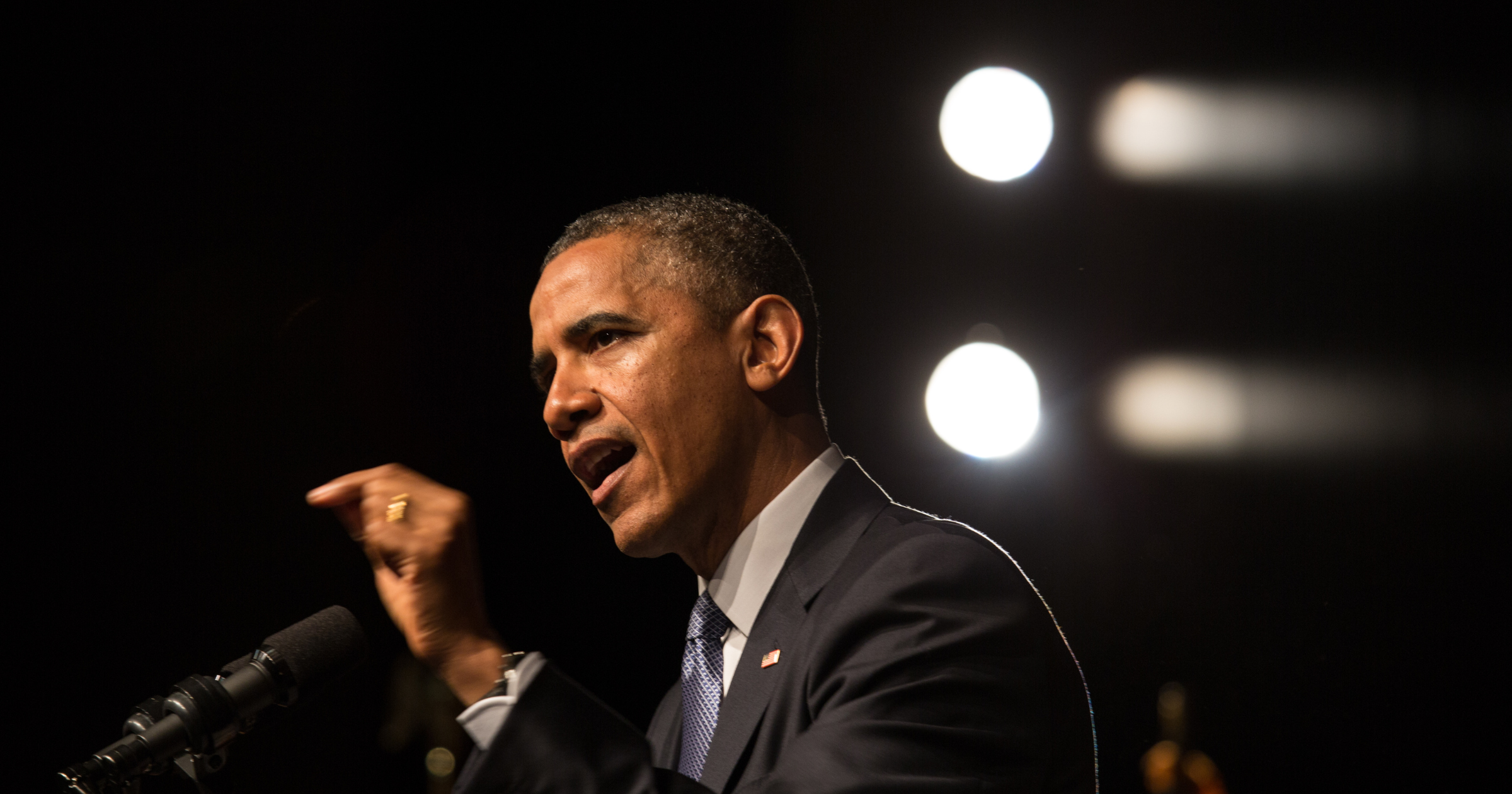



Former President Barack Obama is warning that more than 16 million Americans could lose their health care if the Big Beautiful Bill passes the House this week. He argues that the bill’s proposed cuts to Medicaid funding and weakening of the Affordable Care Act would increase costs for working-class families and leave millions without coverage. Obama called on Americans to contact their representatives, saying this bill risks undoing progress made over the last decade to expand health care access.
More than 16 million Americans are at risk of losing their health care because Republicans in Congress are rushing to pass a bill that would cut federal funding for Medicaid and weaken the Affordable Care Act.
If the House passes this bill, it will increase costs and hurt…
— Barack Obama (@BarackObama) July 2, 2025
Supporters of the bill argue that the Affordable Care Act has failed to deliver the affordable premiums and expanded access it promised. They point out that premiums remain high for many families, and some critics say the ACA is simply an inefficient wealth transfer that has not improved care quality. Republican backers of the bill maintain that reducing federal health care spending is necessary to address the national debt and that states should have greater flexibility in managing Medicaid programs without federal mandates.
Meanwhile, defenders of the ACA warn that provisions in the Big Beautiful Bill would push millions off insurance rolls and strain hospitals already stretched thin. They argue that cutting Medicaid will lead to higher uncompensated care costs for local health systems and leave vulnerable Americans without any realistic coverage options. With a House vote expected soon, the debate continues over whether this bill is a long-overdue correction of failing health care policy or a dangerous rollback of essential protections for millions.
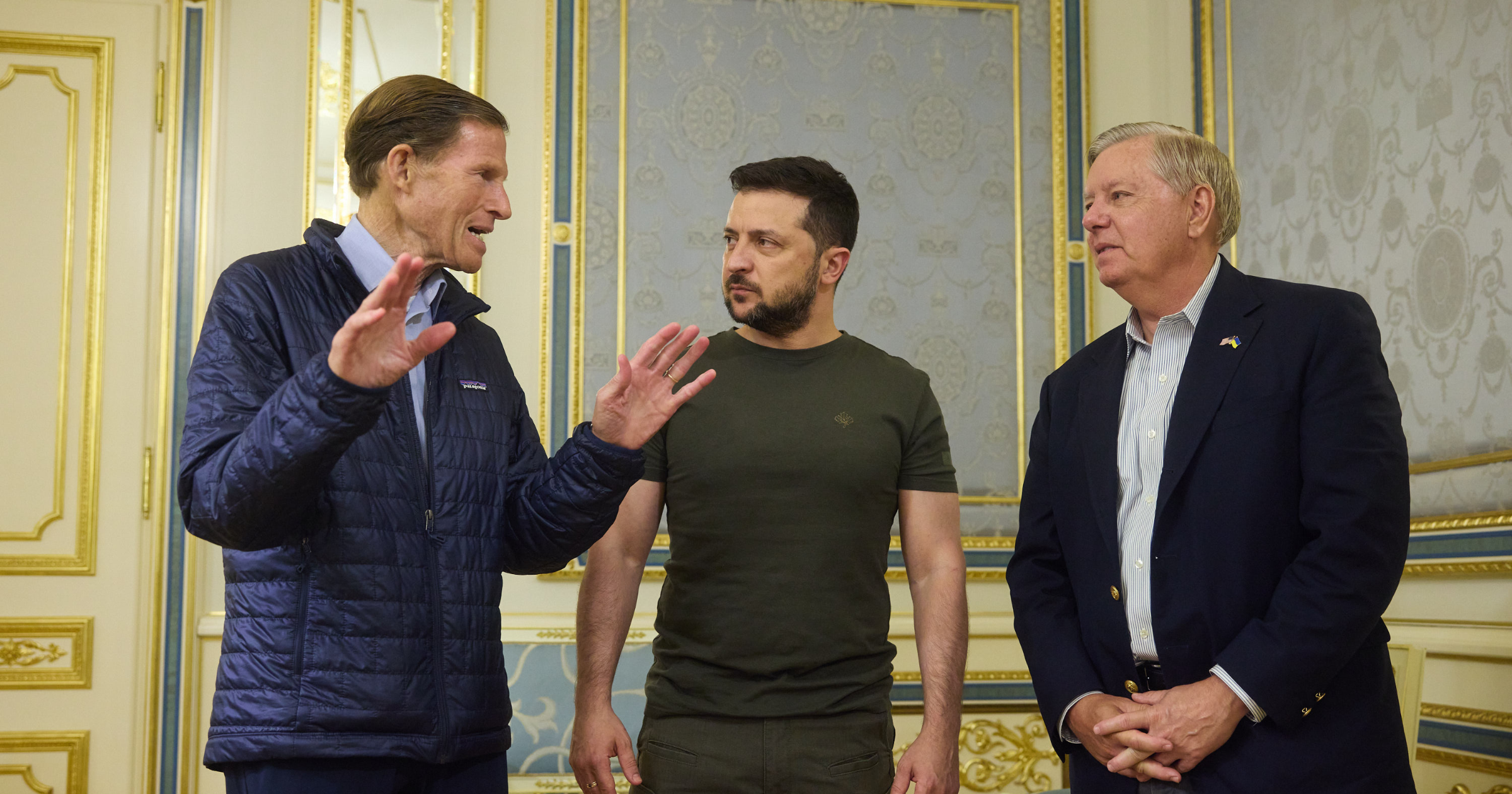
“President Volodymyr Zelenskyy meets with US Senators Lindsey Graham and Richard Blumenthal” by The Presidential Office of Ukraine is licensed under CC BY 4.0 
 .
.
The Pentagon is holding back deliveries of certain missiles and artillery to Ukraine, arguing that America’s own stocks are stretched thin. This decision, shaped by a recent internal review, has sparked concern that Ukraine will be left more vulnerable to Russia’s relentless strikes.
President Trump himself echoed these stockpile worries just weeks ago when asked about sending Patriot systems to Ukraine, saying bluntly, “We need them too.” But Senator Richard Blumenthal is calling the current halt “deeply dangerous,” accusing defense leaders of relying on what he describes as a “dumb and disingenuous” justification.
Blumenthal argues the real threat comes from refusing to produce enough weapons to meet both U.S. and allied needs. He warns that withholding arms abandons Ukraine’s defenders at a critical moment and undercuts America’s standing as a reliable partner. He says he plans to work with lawmakers on both sides to reverse what he sees as a short-sighted and harmful decision.
DOD stopping shipments of critical arms to Ukraine is deeply dangerous&disappointing. It jeopardizes civilians enduring Putin’s missiles&drones—a rain of terror from the skies. It betrays brave men & women bleeding&dying at the front. It encourages Putin & lets down our allies 1/ https://t.co/5vMG2NeAF0
— Richard Blumenthal (@SenBlumenthal) July 2, 2025
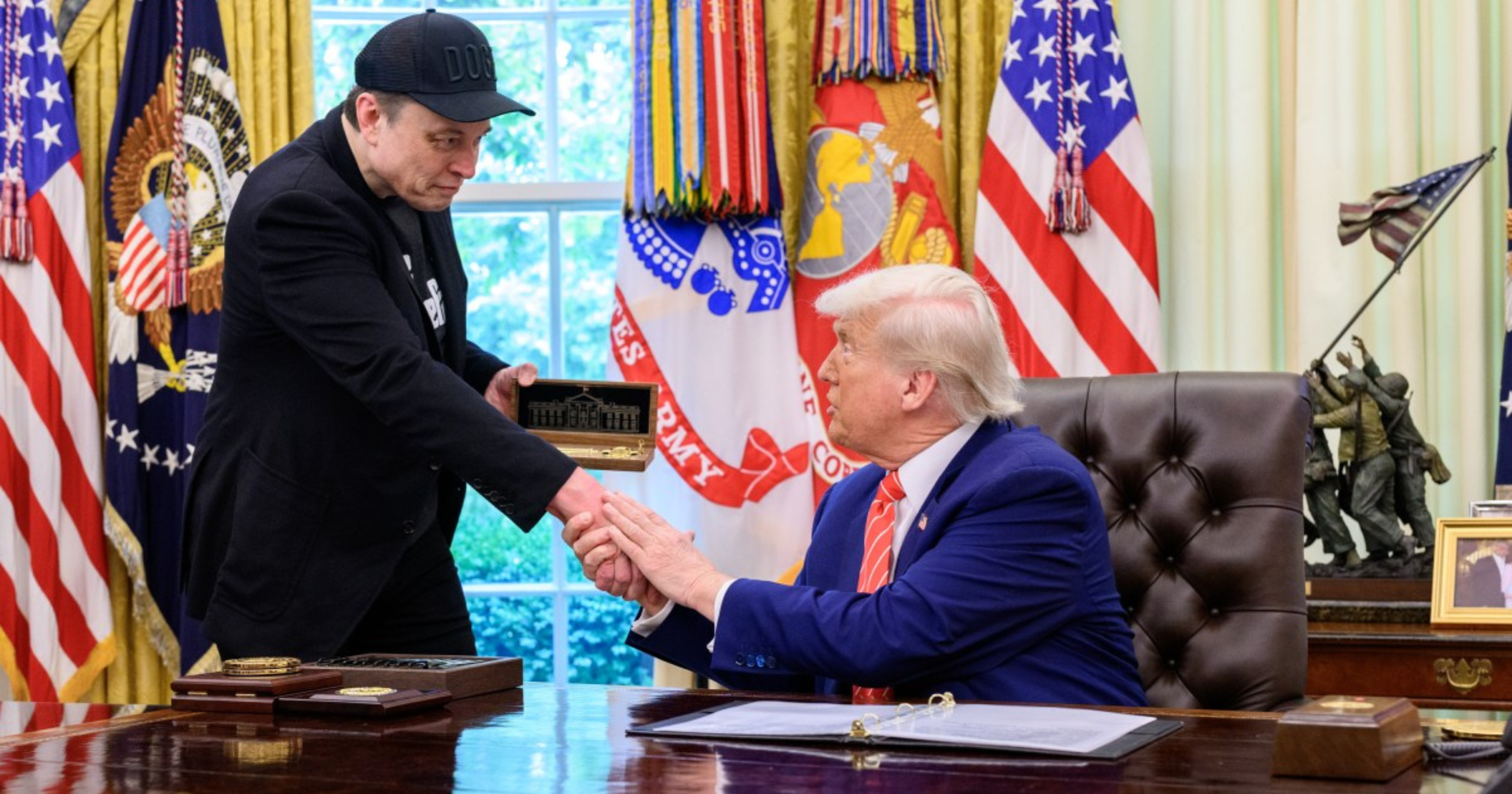
Over the past three months, Elon Musk and President Trump have moved from cooperative to outright adversarial. After Musk’s departure from the Department of Government Efficiency (DOGE) in late May, he sharply condemned Trump’s One Big Beautiful Bill Act, a sweeping $5 trillion tax and spending measure, in a string of X posts describing it as a “pork filled” and “disgusting abomination.” The feud escalated quickly as Trump publicly mocked Musk as having “lost his mind,” threatened to revoke federal contracts with Tesla and SpaceX, and even floated the idea of revoking Musk’s citizenship or deporting him. Musk responded by threatening to form a new America Party and backing anti bill Republicans like Rep. Thomas Massie.
By mid June, the public confrontation intensified. Musk alleged unsubstantiated claims linking Trump to the Jeffrey Epstein files on X, briefly threatened to decommission SpaceX’s Dragon spacecraft, and called for Trump’s impeachment before retracting and apologizing on June 11, tweeting, “I regret some of my posts about President @realDonaldTrump last week. They went too far.” Trump’s response remained firm as he vowed Musk would face “very serious consequences” should he fund Democratic candidates, while market volatility hit Tesla and X stocks on news of the feud.
Yet following those highly public clashes, Musk has extended public praise where due. Last night, he posted, “Credit where credit is due. @realDonaldTrump has successfully resolved several serious conflicts around the world.” This came in response to Trump’s announcement of a proposed 60 day Gaza ceasefire, showing that despite their ongoing political battles, Musk remains willing to acknowledge Trump’s foreign policy actions when he believes they merit credit.
Credit where credit is due. @realDonaldTrump has successfully resolved several serious conflicts around the world. pic.twitter.com/0EyHHy5Gfo
— Elon Musk (@elonmusk) July 2, 2025
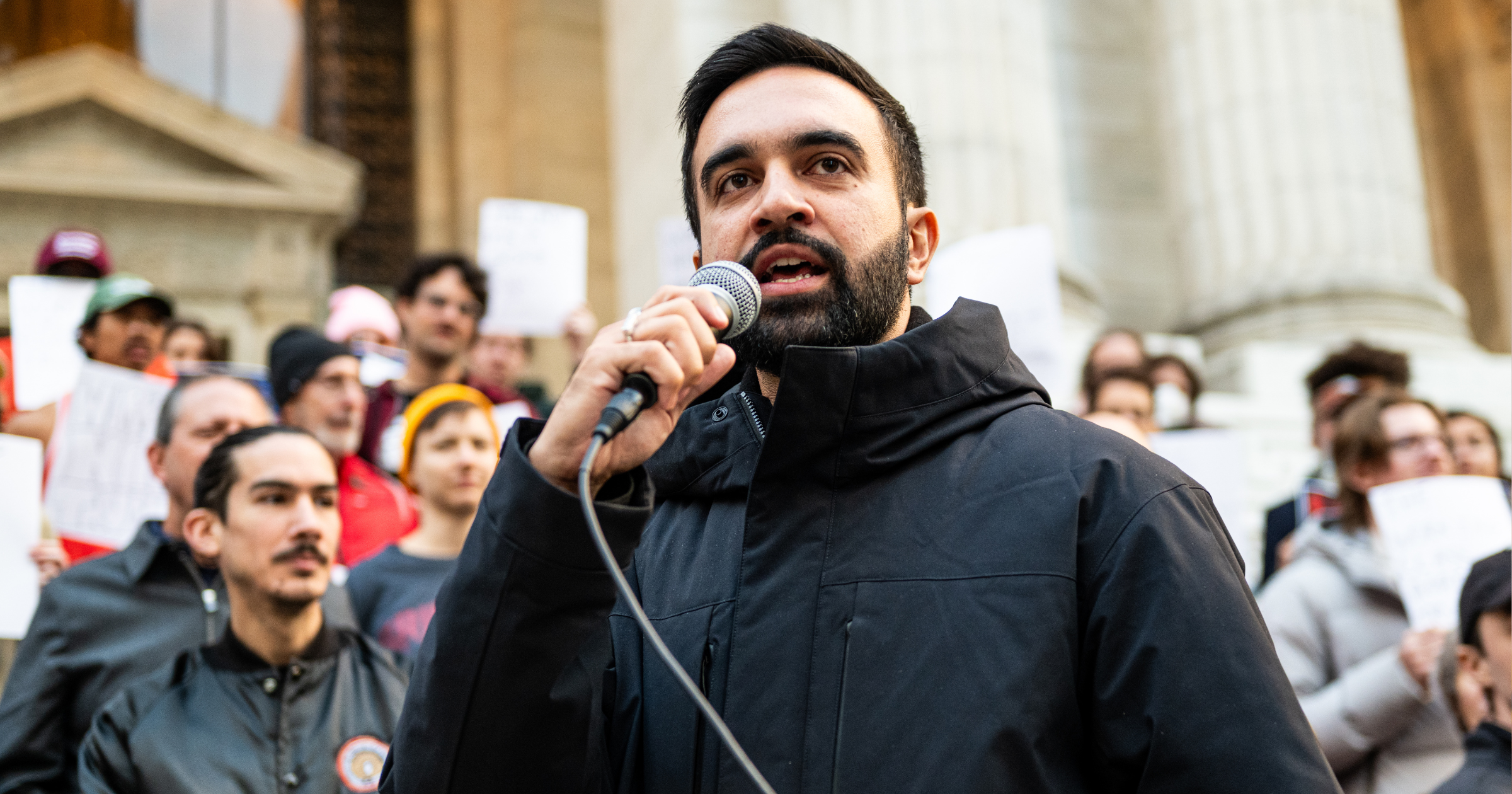
“Zohran Mamdani at the Resist Fascism Rally in Bryant Park on Oct 27th 2024” by Bingjiefu He is licensed under CC BY-SA 4.0  .
.
Zohran Mamdani, the Democratic Socialist who just won New York City’s Democratic mayoral primary, is pushing back after President Donald Trump threatened to have him arrested.
When asked about Mamdani’s pledge to block ICE from arresting undocumented immigrants in the city, Trump told reporters, “Well, then, we’ll have to arrest him. Look, we don’t need a communist in this country, but if we have one, I’m going to be watching over them very carefully on behalf of the nation.” He continued, “A lot of people are saying, he’s here illegally. You know, we’re going to look at everything.”
Mamdani responded with a statement posted to X, writing, “The President of the United States just threatened to have me arrested, stripped of my citizenship, put in a detention camp and deported. Not because I have broken any law but because I will refuse to let ICE terrorize our city.”
He described Trump’s words as an attack on democracy itself, saying they were “an attempt to send a message to every New Yorker who refuses to hide in the shadows: if you speak up, they will come for you.” Mamdani concluded, “We will not accept this intimidation.”
My statement on Donald Trump's threat to deport me and his praise for Eric Adams, who the President "helped out" of legal accountability. https://t.co/m7pNcT2DFS pic.twitter.com/UcYakMx4lI
— Zohran Kwame Mamdani (@ZohranKMamdani) July 1, 2025
The Senate has passed President Donald Trump’s sweeping “Big Beautiful Bill” after a dramatic 50-50 deadlock was broken by Vice President JD Vance. The legislation, which combines major spending provisions with sweeping border security measures, cleared the chamber late Tuesday following days of tense negotiations and public pressure campaigns by the White House.
Vice President Vance cast the deciding vote, declaring, “On this vote, the yeas are 50, the nays are 50, the Senate being equally divided, the Vice President votes in the affirmative, and the amendment is agreed to.” His formal announcement delivered the administration a critical legislative win, advancing one of the largest funding packages of Trump’s second term.
The bill now returns to the House for approval of Senate amendments before it can move to President Trump’s desk for signature. Final House consideration could occur within days, setting up a potential signing ceremony later this week. Supporters say it will overhaul immigration enforcement and unlock historic federal investments, while critics argue it adds unsustainable debt and expands executive power.
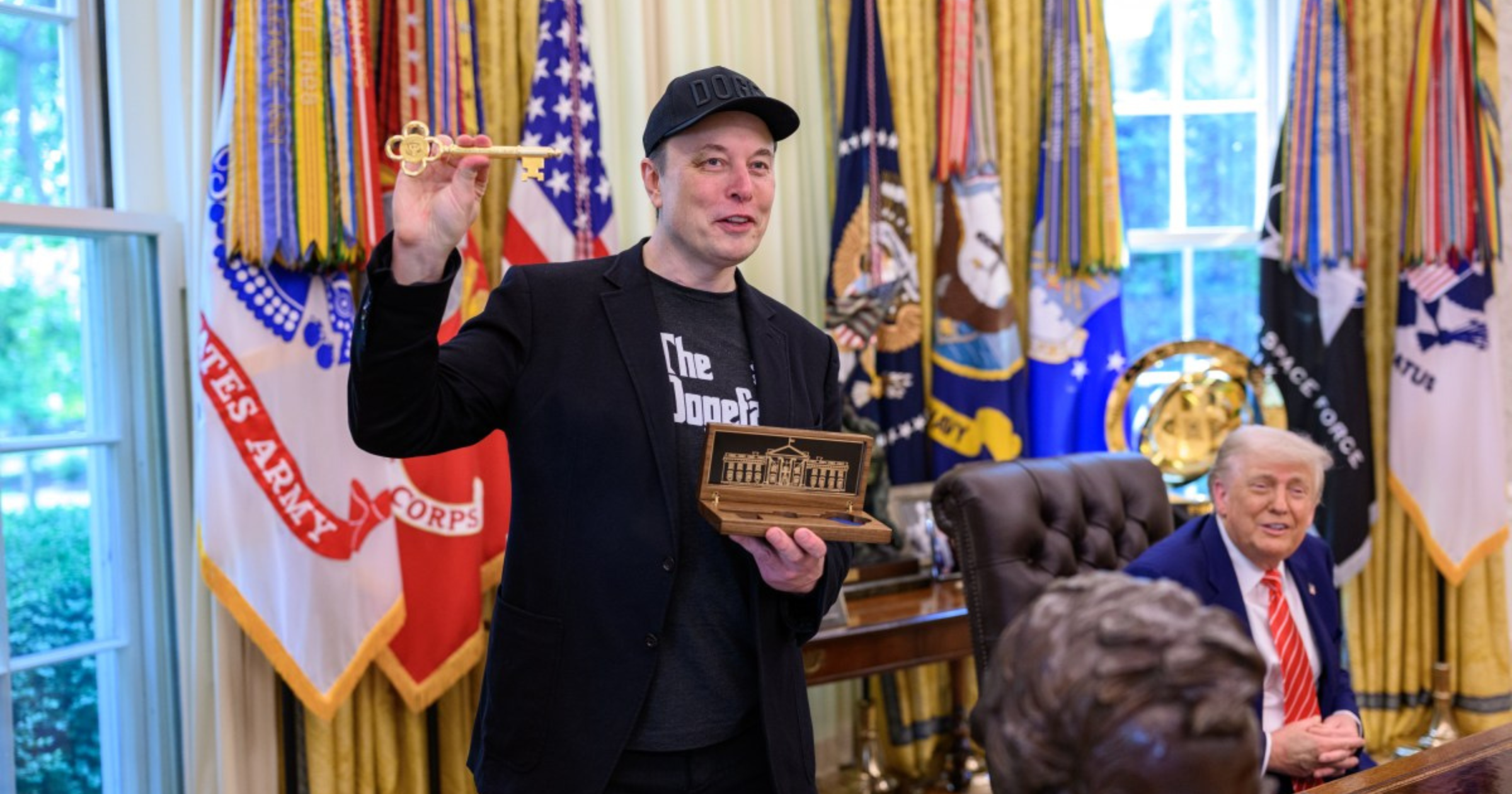
President Donald Trump reiterated a sharp warning to Elon Musk while taking questions from members of the press outside Florida’s newly opened immigration facility, nicknamed “Alligator Alcatraz.” When asked whether Musk’s criticism of Trump’s sweeping spending and border security bill could sway Republican votes, Trump dismissed the concern before turning his attention directly to Musk.
“DOGE is gonna look at Musk, and if DOGE looks at Musk, we’re gonna save a fortune. I don’t think he should be playing that game with me,” Trump said. His remark referred to the Department of Government Efficiency, the federal agency Musk previously led before stepping down earlier this year. The implication was clear: Trump is prepared to turn the very regulatory agency once shaped around Musk’s tech-driven cost-cutting philosophy directly against him, if Musk continues to publicly oppose the bill.
This was not the first time Trump issued such a threat. In a Truth Social post the night before, Trump said, “Perhaps we should have DOGE take a good, hard look at this? BIG MONEY TO BE SAVED!!!” while accusing Musk of relying on government subsidies to keep his companies afloat. The combined comments mark a stark escalation in their relationship, signaling that in Trump’s administration, even former allies may find their own creations used as leverage against them.
Elon Musk is signaling his support for Rep. Thomas Massie, even as former President Trump intensifies his attacks. Both Musk and Massie share a deep dislike for what Trump calls his “Great, Big, Beautiful Bill,” which includes major government spending alongside tax cuts. While Massie has opposed the bill for increasing federal spending and adding to the national debt, Musk has criticized it for the same reason, arguing that it irresponsibly expands the deficit. Their shared opposition to large-scale spending has become a point of unity between the libertarian-minded congressman and the billionaire tech entrepreneur.
Today, Massie shared a Fox News article reporting that Musk plans to donate to his re-election campaign. Musk replied, “You’re awesome,” prompting Massie to thank him and say that his job is to keep government from “screwing things up” for engineers and entrepreneurs like Musk.
An interesting thing just happened:https://t.co/78ioUfmVIo
— Thomas Massie (@RepThomasMassie) July 1, 2025
But Trump isn’t impressed. In a recent post, he called Massie a “Third Rate Congressman” and a “LOSER” for opposing what he calls “The Great, Big, Beautiful Bill” that includes major tax cuts and other Republican priorities. Trump accused Massie of voting “NO” on everything just to seem cool. In another post, Trump attacked Musk directly, claiming Musk gets more subsidies than any human in history and suggesting he would have to “head back home to South Africa” without them. Trump wrote, “Perhaps we should have DOGE take a good, hard look at this? BIG MONEY TO BE SAVED!!!”
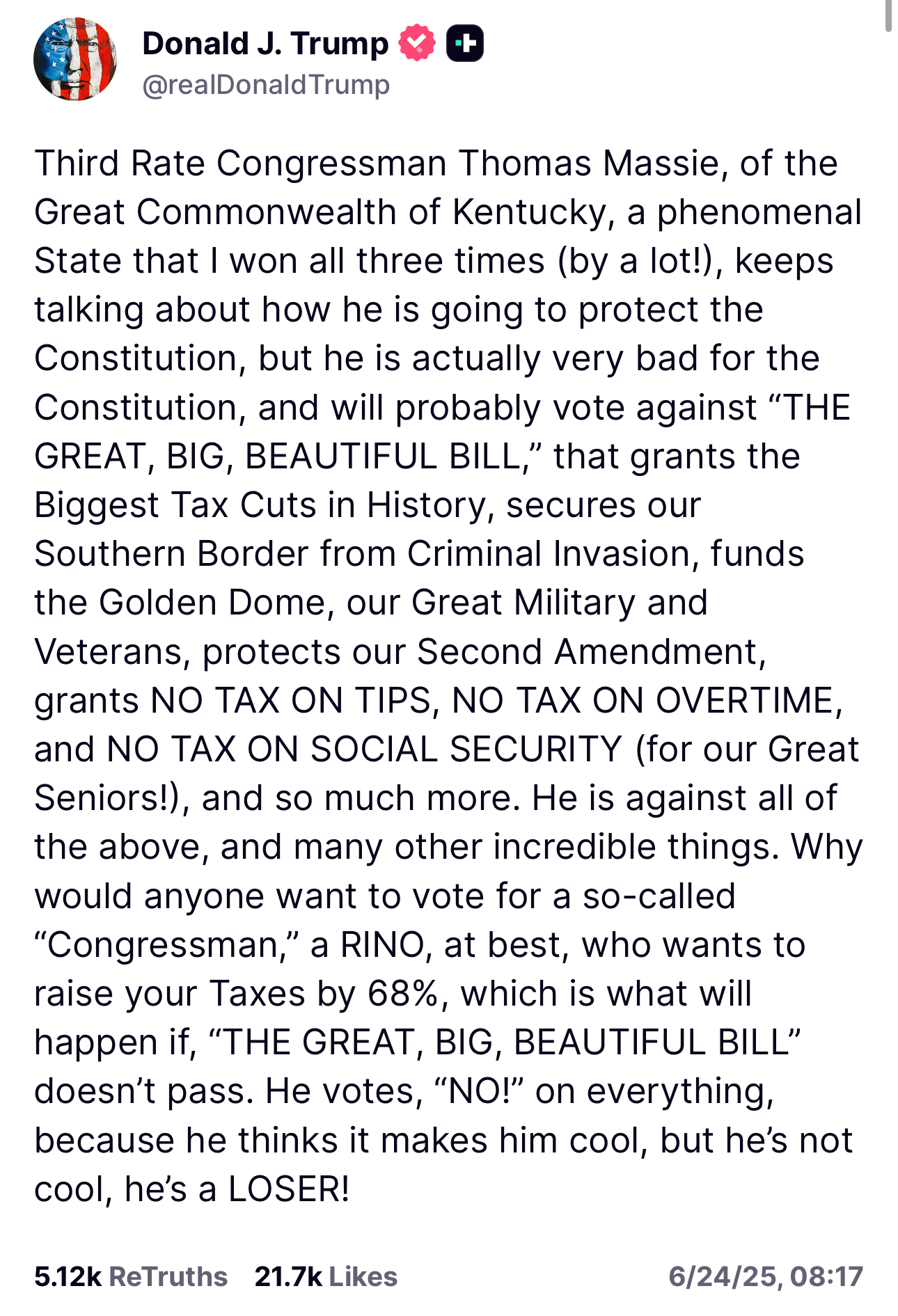
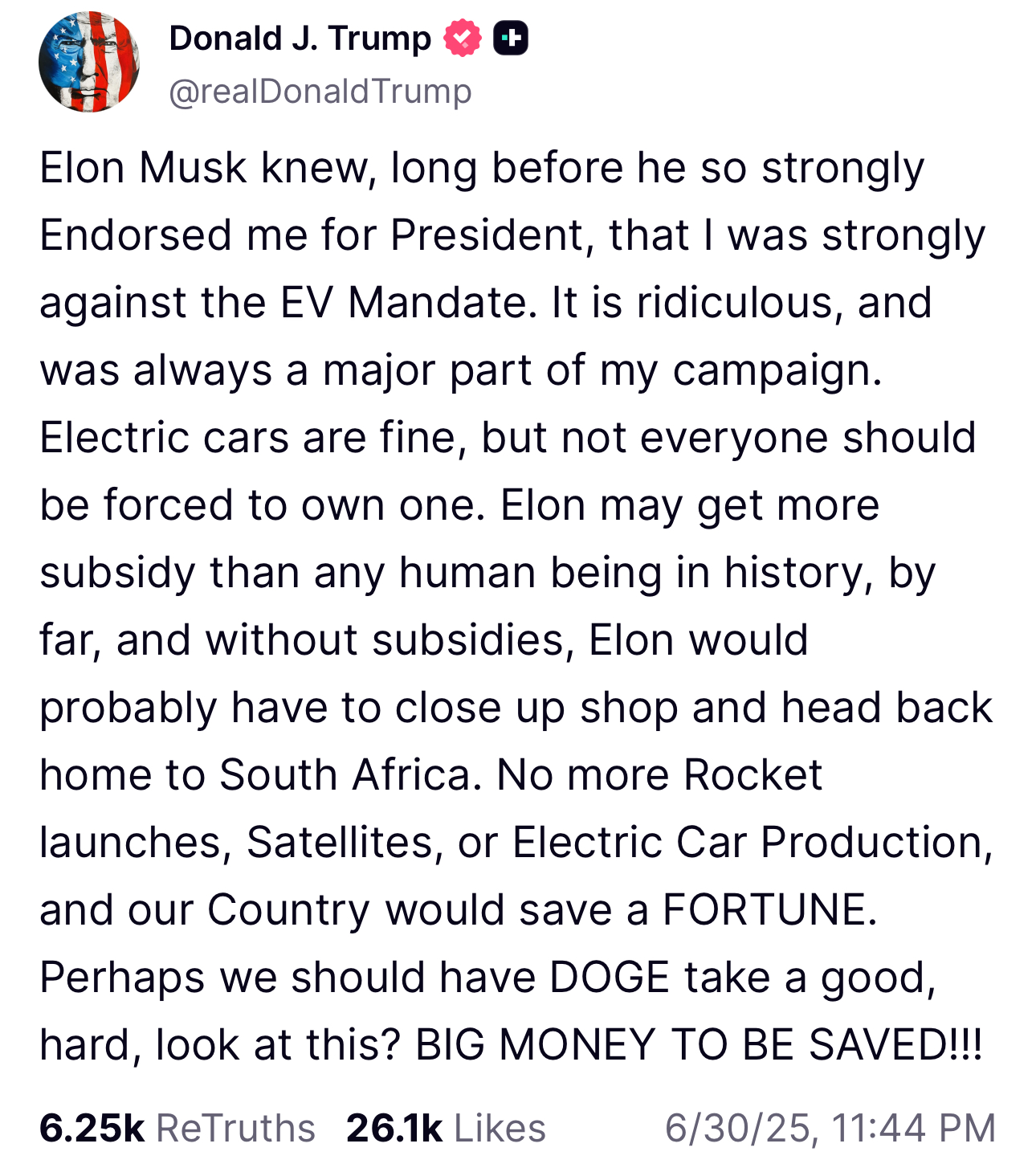
These posts highlight a deepening split in the Republican ranks. While Musk backs Massie’s libertarian votes against government spending, Trump is warning that Massie’s opposition will cost Americans tax cuts and border security. For Musk, it may be about protecting innovation. For Trump, it’s about protecting his legislative agenda.
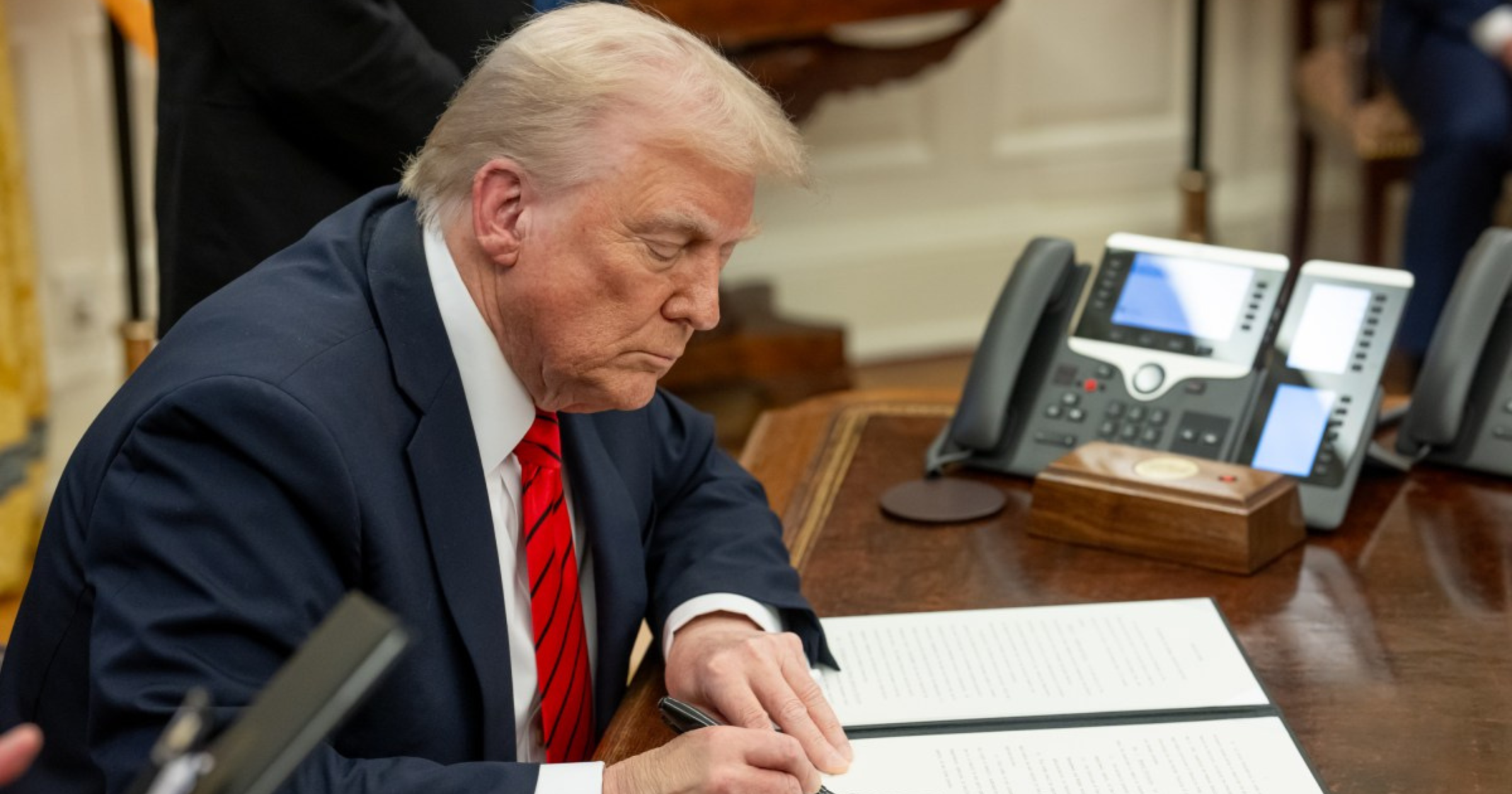
President Trump has signed an executive order officially revoking the United States sanctions program on Syria, fulfilling what the White House calls another “promise made and promise kept” to promote peace and stability in the region.
The order terminates broad sanctions on Syria’s economy while maintaining restrictions on Bashar al-Assad, his inner circle, and individuals linked to human rights abuses, drug trafficking, and chemical weapons. According to the White House fact sheet, it also keeps in place sanctions targeting ISIS affiliates and Iranian proxies. However, in a move that has drawn little public attention, the order directs the State Department to review and potentially lift terrorist designations on Hay’at Tahrir al-Sham (HTS) and its leader, Ahmed al-Sharaa.
During her press briefing today, White House Press Secretary Karoline Leavitt framed the move as a decisive victory for American diplomacy. She emphasized that the president “is committed to supporting a Syria that is stable, unified, and at peace with itself and its neighbors.” She added that the executive order was designed to remove barriers to economic growth while maintaining pressure on those who threaten regional security.
HTS, a former al-Qaeda affiliate, currently controls much of northwest Syria. Its leader, Ahmed al-Sharaa, is a figure once widely seen as a global terrorist. Under the new executive order, the administration will begin the process of delisting HTS and al-Sharaa from U.S. terrorism designations. The fact sheet describes this as part of America’s commitment to “supporting Syria’s path to stability and peace.”
Leavitt, echoing the president’s framing, portrayed the change as a long-overdue correction to the previous administration’s failures. “The last administration propped up chaos with ineffective sanctions that punished ordinary people,” she said. “President Trump is removing those barriers to peace and prosperity while keeping America safe from terrorists, human rights abusers, and Iranian proxies.”
Critics warn that delisting HTS risks legitimizing a group with a violent militant history, potentially undermining counterterrorism efforts in the region. The administration argues that HTS is no longer an al-Qaeda affiliate and has transitioned to a local governing force willing to engage in diplomacy and maintain security in its territories. The White House has not indicated any plans to consult Congress before finalizing the delisting process.
This executive order goes further than the earlier 180-day waiver of Caesar Act sanctions issued in May. It fully terminates economic sanctions, clears the way for international investment, and directs the Secretary of State to seek formal U.N. sanctions relief for Syria.
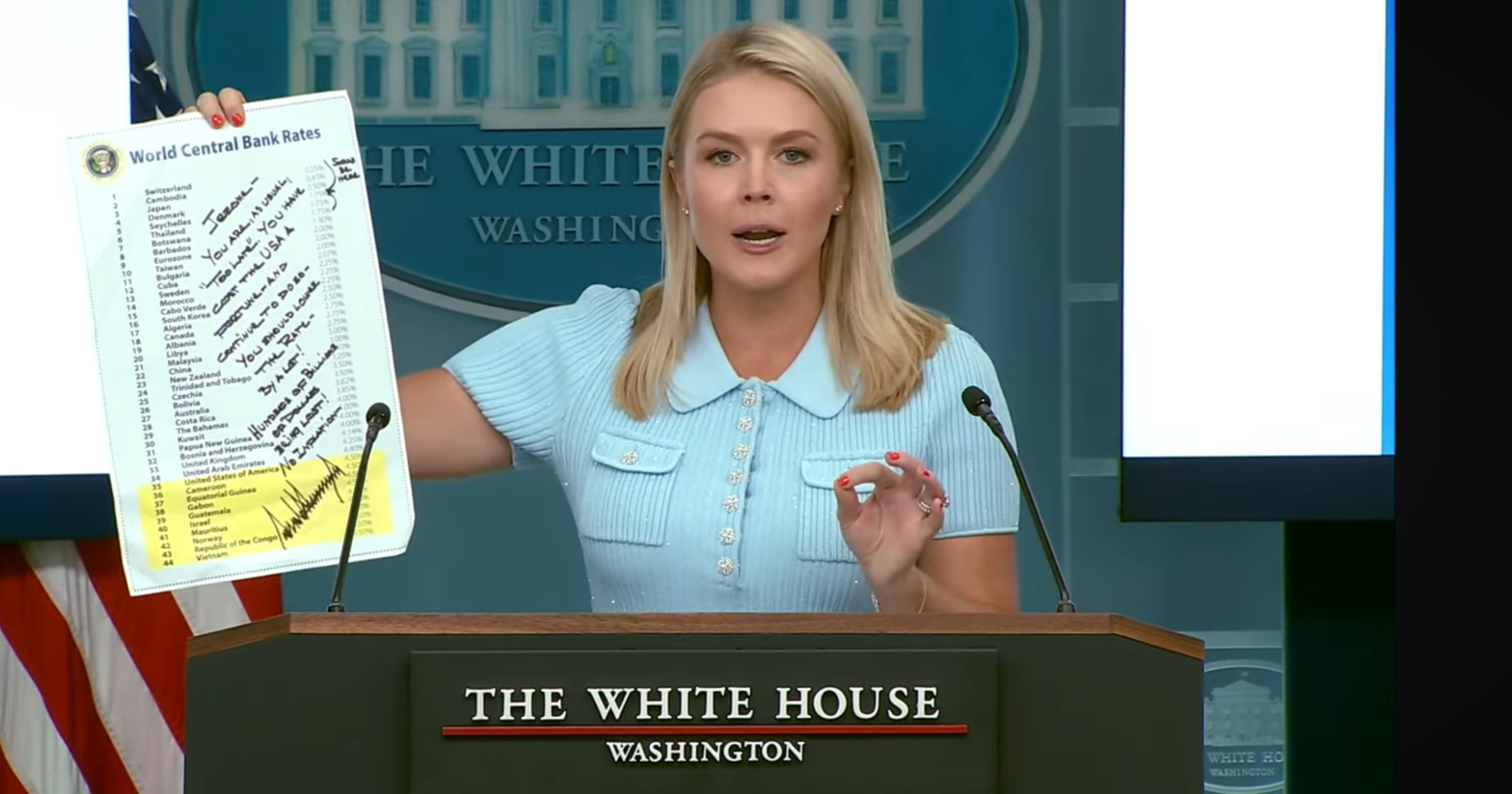
During today’s White House press briefing, Press Secretary Karoline Leavitt revealed that President Trump sent a handwritten note to Federal Reserve Chair Jerome Powell, demanding immediate and substantial interest rate cuts. The note was written directly onto a printed chart comparing U.S. interest rates to those of other countries. Reading it aloud, Leavitt quoted Trump’s words: “Jerome – You are, as usual, ‘too late’. You have cost the USA a fortune. And continue to do so. You should lower the rate by a lot! Hundreds of billions of dollars being lost! No inflation.”
Leavitt used the note to underscore the administration’s message that U.S. rates remain unnecessarily high, despite what she called “historically low inflation thanks to the President’s policies.” She told reporters that Trump believes Americans deserve cheaper borrowing costs and that his economic approach “worked in his first term and it is working again.” According to Leavitt, the chart attached to the note showed that countries ranging from Switzerland to Cambodia have lower rates despite weaker economies.
The press secretary argued that lowering rates would unlock further growth, ease household financial burdens, and extend what she described as the “Trump economic boom” marked by record-high stock markets and the lowest summer gas prices in four years. This handwritten note is the latest example of Trump’s direct pressure campaign on Powell as the administration seeks aggressive rate cuts to support its economic and legislative agenda in the coming weeks.
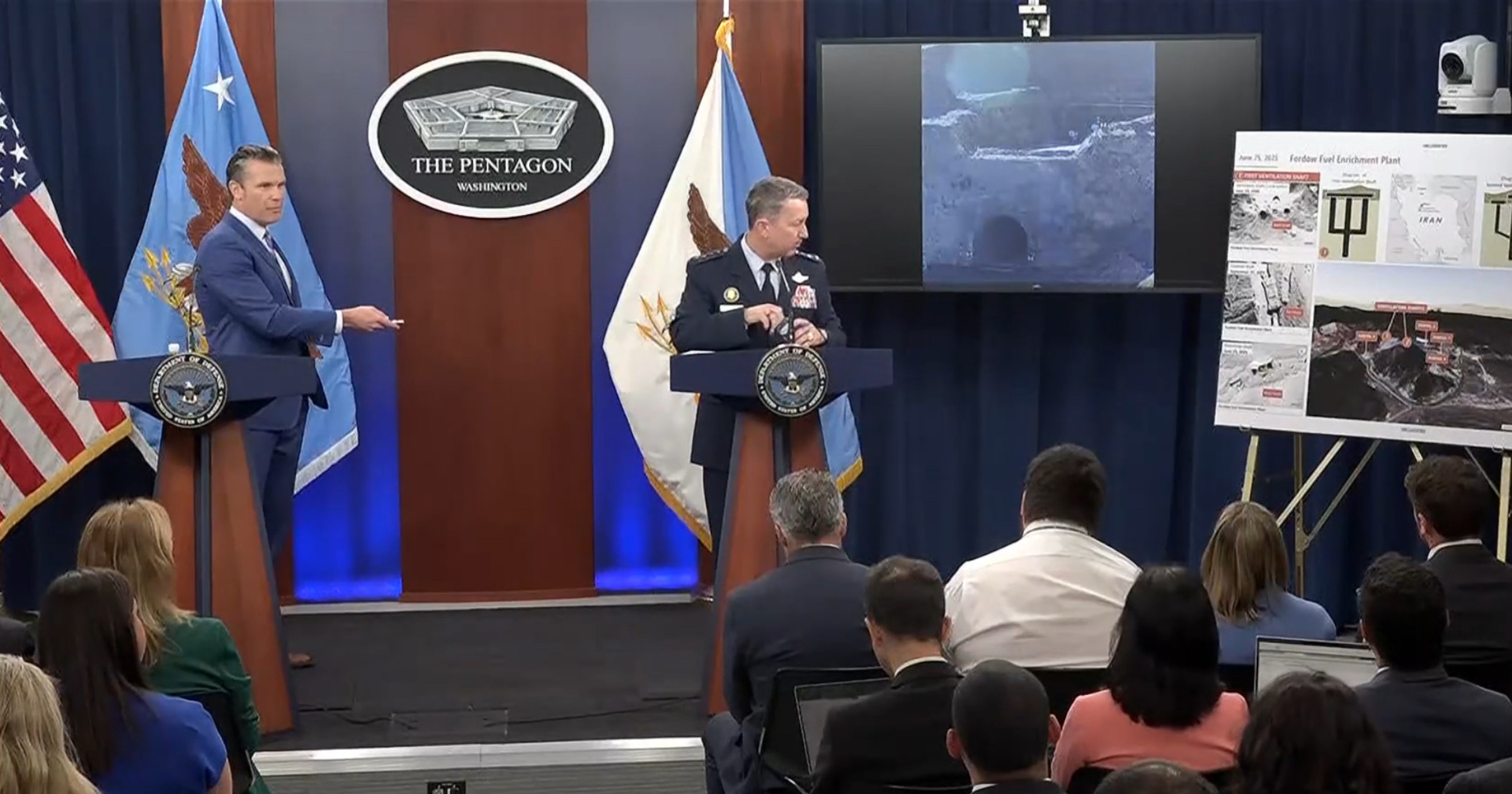
Secretary of Defense Pete Hegseth and General Dan Caine delivered a detailed briefing on what they called one of the most complex and successful military operations in U.S. history. The strike, part of “Operation Midnight Hammer,” targeted Iran’s Fordow nuclear facility using GBU-57 Massive Ordnance Penetrators, each one precisely calibrated for angle, fuse setting, and impact location. General Caine said, “All six weapons at each vent at Fordow went exactly where they were intended to go.”
The officials rejected early media reports questioning the success of the mission. Hegseth singled out a leaked preliminary DIA assessment, calling it “a preliminary, low confidence report,” and noting that it included “multiple linchpin assumptions.” He warned that its release was part of an effort “to try to muddy the waters and make it look like this historic strike wasn’t successful.” He argued that “anyone with two eyes, some ears and a brain” could understand that a strike of this scale and precision would have a “devastating effect.”
They cited a range of external confirmations. Hegseth quoted the CIA director’s statement: “A body of credible intelligence indicates Iran’s nuclear program has been severely damaged by recent targeted strikes.” He added that sources referenced were “historically reliable and accurate.” Officials also referenced comments from the Israeli Atomic Energy Commission, the U.N. Atomic Energy Agency, and even an Iranian Foreign Ministry spokesperson who admitted, “Our nuclear infrastructure has been badly damaged, that’s for sure.”
General Caine also detailed the U.S. air defense effort that followed. At Al Udeid Air Base in Qatar, just 44 U.S. soldiers manned two Patriot batteries to defend against incoming Iranian missiles. He called it “the largest, single Patriot engagement in U.S. military history,” describing how young officers had just seconds to make decisions with “strategic impact.” He credited both American and Qatari crews for “standing between a salvo of Iranian missiles and the safety of Al Udeid.”
The planning behind the strike spanned more than 15 years. According to Caine, two officers from the Defense Threat Reduction Agency had spent their careers studying the Fordow site, monitoring “every nook, every crater, every piece of equipment going in, and every piece of equipment going out.” He described the final outcome as the result of “hundreds of test shots” and “supercomputer hours” used to develop the right weapon. “They literally dreamed about this target at night when they slept,” he said.
Officials emphasized that while full intelligence assessments are still ongoing, key indicators are already clear. Caine stated: “We know that the trailing jets saw the first weapons function and the pilot stated, ‘This was the brightest explosion that I’ve ever seen. It literally looked like daylight.’” As for the emotional weight of the mission, he shared that when the crews returned to Whiteman Air Force Base, “there were a lot of flags and a lot of tears.”
Asked whether Iran moved enriched uranium before the strike, officials said they had seen no such intelligence. On the question of internal pressure to exaggerate the outcome, General Caine replied, “No, I have not and no, I would not.” He added, “My job as a chairman is to offer a range of options… and go execute them.”
Hegseth closed by framing the operation as a turning point. “Call it destroyed, call it defeated, call it obliterated, choose your word. This was an historically successful attack.” While he acknowledged that Iran might make defiant public statements, he insisted that the mission created “an opportunity to prevent a nuclear Iran” and “a chance to have peace.”